

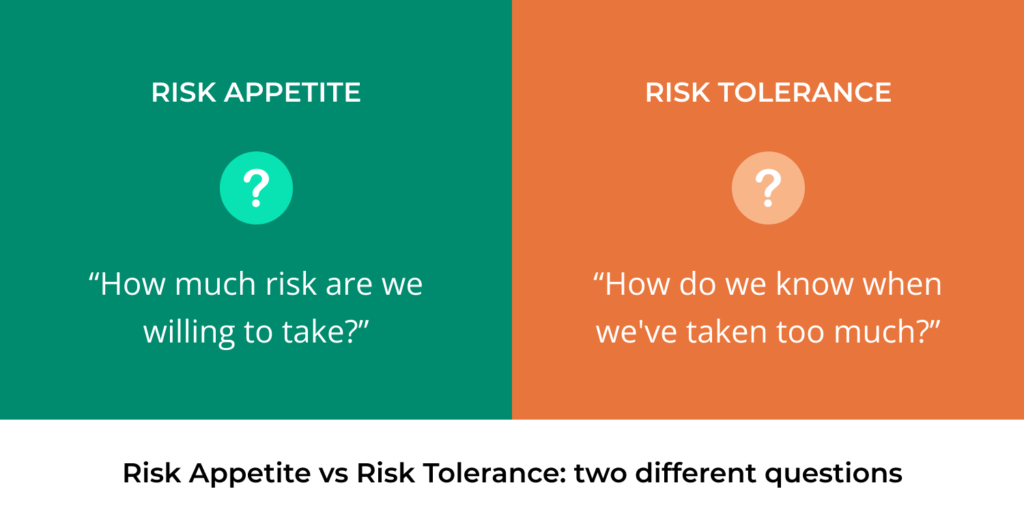
Risk appetite defines the amount of risk an organisation is willing to accept in pursuit of its strategic objectives. Risk tolerance translates that appetite into specific, measurable limits for operational activities. While risk appetite sets the strategic direction, risk tolerance establishes the thresholds that trigger action when exceeded.
Risk appetite and risk tolerance are two concepts central to risk management. They appear in frameworks, regulatory submissions, and board-level conversations. They are also regularly conflated, oversimplified, or treated as synonyms, with real operational consequences.
Organisations that distinguish between the two and apply them consistently make decisions against concrete limits, not general intentions. Their risk position is something they can demonstrate, not just declare. Organisations that do not make this distinction build frameworks that look coherent on paper but cannot guide a decision when one needs to be made.
The difference is straightforward to describe: risk appetite operates at the strategic level, risk tolerance at the operational level. The difficulty is not in understanding that distinction; it is in translating it into specific thresholds, named owners, and monitoring systems. That step, from declaration to mechanism, is where most organisations stop short.
What Is Risk Appetite?
Risk appetite expresses an organisation’s overall willingness to accept risk in pursuit of its strategic objectives. It’s a set of directional positions across risk categories: financial, operational, compliance, reputational, and others relevant to the organisation’s context.
The COSO ERM framework treats risk appetite as a precondition for strategy-setting: before objectives can be agreed, the organisation determines how much risk it is prepared to absorb in pursuing them. ISO 31000 places appetite in the risk management framework, the foundation that gives downstream decisions a shared reference point.
A declaration that reads “we take a conservative approach to financial risk” gives a risk manager very little when evaluating a specific transaction. Appetite becomes actionable when it is specific enough to distinguish acceptable positions from unacceptable ones, and when it is formally linked to the tolerance levels derived from it. Until that link exists, the appetite statement is a governance artefact, not a management tool.
Risk appetite is owned at the board level. It should reflect the organisation’s strategic ambitions, its capacity to absorb losses, and the expectations of regulators and investors.
What Is Risk Tolerance?
Risk tolerance defines the acceptable level of variation from the organisation’s stated appetite in a specific operational area or process. Where appetite is directional, tolerance is quantitative: it sets the boundary at which risk becomes unacceptable in practice.
Tolerances are expressed as measurable thresholds: a maximum error rate, a loss limit, a percentage deviation from a compliance benchmark, a number of permitted exceptions per period. These figures appear in KRI dashboards, audit criteria, and monitoring reports. They are the numbers that tell a process owner whether today’s results require action.
Risk tolerance is derived from risk appetite, not defined independently of it. If the appetite says “low operational risk,” each relevant process needs a tolerance level that operationalises what “low” actually means in that context. Without that translation, appetite and tolerance are two separate documents with no operational connection between them.
Risk tolerance is set and maintained by process owners and risk managers, with oversight from the risk function to ensure consistency across the organisation. The IIA’s standards for risk-based internal auditing make explicit that internal audit should assess whether controls are calibrated to tolerance levels, not just to general risk categories.
Risk Appetite vs Risk Tolerance: Key Differences
The table below summarises the core differences across the dimensions that matter most in practice.
| Dimension | Risk Appetite | Risk Tolerance |
|---|---|---|
| Level: | Strategic | Operational |
| Expressed as: | Qualitative or semi-qualitative | Quantitative (KPIs, limits, thresholds) |
| Set by: | Board / senior leadership | Risk owners, process managers |
| Applied in: | Strategy-setting and planning | Monitoring, controls, reporting |
| Scope: | Whole organisation or major risk categories | Specific processes or risk areas |
| Reviewed when: | Strategy changes | Conditions or processes change |
| Visible in: | Risk appetite statement, framework documents | KRI dashboards, audit criteria, escalation protocols |
The last row is the most telling. Risk tolerance levels that do not appear in dashboards, audit work, or escalation triggers are not controls; they are records of intent.
How Risk Appetite Translates into Risk Tolerance?
The translation from appetite to tolerance is where most risk frameworks lose precision. The appetite statement for a given risk category should generate the risk tolerance for all processes and decisions within it. Two things reliably break that chain.
The first is abstraction that never resolves into specifics. An appetite statement that says “moderate risk in technology operations” does not tell a system owner what constitutes a breach. The statement needs to be decomposed: “moderate” in this context means what metric, measured how, against what threshold? Until those questions are answered, the appetite has no operational effect.
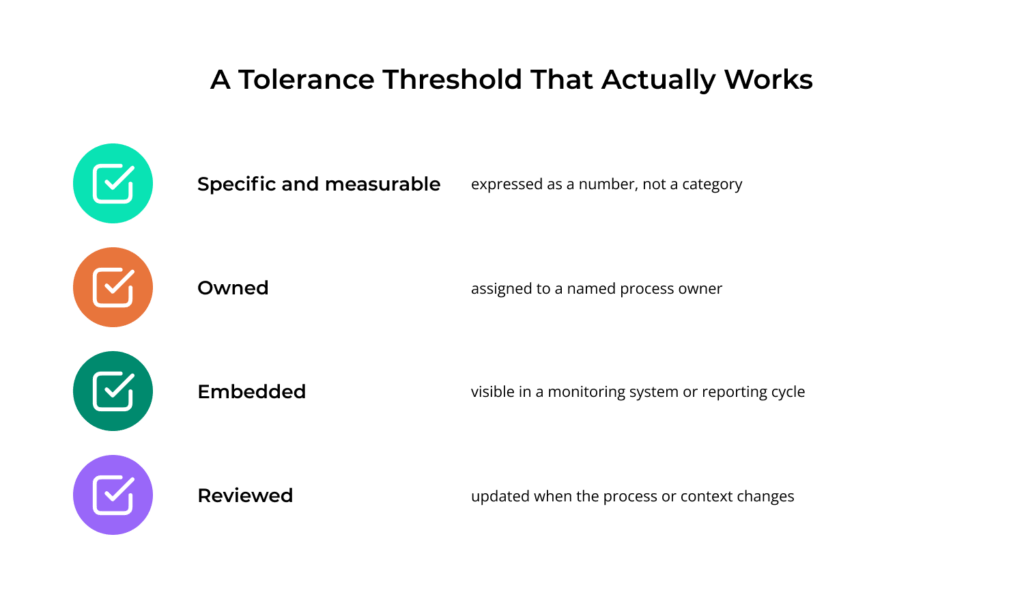
The second is missing ownership; a tolerance threshold without a named owner is information, not a control mechanism. Someone must be responsible for monitoring it, reporting on it, and triggering an escalation when it is breached. Without that accountability, tolerance levels are consulted during audits and forgotten in between.
The practical sequence: for each risk category, take the appetite statement and identify the processes that fall within it. For each process, determine the metrics that measure risk exposure. Set quantitative thresholds that reflect the appetite level and that can be monitored regularly. Assign each threshold to a process owner, then build it into the relevant monitoring system or reporting cycle.
That last step matters more than it may appear. Thresholds that live only in a risk register are not embedded in operations; they need to be visible where decisions are actually made.
Practical Examples in Finance and IT
Financial services
A bank defines its credit risk appetite as “moderate”: prepared to accept losses within a range that does not threaten capital ratios. From that appetite, the risk function derives tolerance levels for individual loan portfolios: a maximum non-performing loan ratio of 3.5% in the retail segment, 2% in commercial lending. Each portfolio manager receives a threshold and a reporting obligation. When the NPL ratio approaches the limit, an escalation protocol activates. It does not wait for a quarterly review.
IT
A technology company defines its operational risk appetite as “low” in systems availability. The corresponding tolerance is 99.5% uptime per quarter for production systems, with a 4-hour maximum recovery time for critical incidents. These figures go directly into SLA definitions, vendor contracts, and the internal audit programme. A breach triggers a formal incident review, not just a note in the risk register.
Compliance function
An organisation subject to NIS2 defines its compliance risk appetite as “very low.” The tolerance threshold for overdue policy exceptions is zero for critical controls. Any exception generates an immediate escalation to the CISO. Quarterly board reporting includes the number of exceptions raised and resolved, mapped against the threshold.
In each case, the tolerance level is not a number in a document; it is a trigger in an operational system.
Defining Appetite and Setting Limits: Roles and Responsibilities
Risk appetite is a board-level responsibility; the board determines how much risk the organisation is prepared to absorb across major categories, informed by strategy, financial capacity, regulatory obligations, and stakeholder expectations. The risk function supports this by providing analysis, framing options, and checking that the appetite statement is specific enough to generate actionable tolerance levels.
Risk tolerance belongs to process owners; they set the thresholds for their areas, drawing on operational knowledge that the risk function does not have. The risk function’s role is to provide the framework, ensure consistency across units, and validate the thresholds against the appetite; it should not be defining operational limits itself.
Where this breaks down is when risk functions define tolerances in isolation, or when process owners set thresholds without reference to the appetite; both produce numbers that cannot be justified and are unlikely to be used.
| Role | Responsibility | Owns |
|---|---|---|
| Board | Defines the organisation’s strategic risk position across major categories | Risk Appetite |
| Risk Function | Translates appetite into a framework and validates consistency across the organisation | Framework and Validation |
| Process Owners | Set quantitative thresholds for their areas and monitor them against defined limits | Risk Tolerance |
KRI Monitoring and Risk Indicators
Risk tolerance only becomes a control when it is connected to risk management systems that can detect breaches in time to act on them.
Key risk indicators (KRIs) should be calibrated to the tolerance levels the organisation has set. A KRI that tracks “number of risk events logged” tells you about reporting behaviour. A KRI that tracks “percentage of transactions exceeding the defined loss tolerance” tells you about actual risk exposure. The distinction matters when presenting results to the board or a regulator.
The reporting cycle should surface breaches before they compound. For high-severity risk areas, this means near-real-time alerting, not period-end summaries. A quarterly report on a monthly tolerance breach is information delivered three months too late.
GRC platforms that integrate risk appetite, risk tolerance, KRI monitoring, and escalation workflows reduce the manual coordination burden considerably, particularly for organisations managing multiple risk categories across business units. In regulated environments where compliance and risk monitoring must operate in sync, the integration also produces an audit trail regulators can examine: evidence that the organisation knew its risk boundaries and operated within them.
Common Mistakes and How to Avoid Them
The most persistent mistake is treating appetite and tolerance as permanent once approved. Risk appetite should be reviewed when strategy changes. Risk tolerance should be reviewed when processes, systems, or external conditions shift. A threshold calibrated for a manual process may be meaningless after automation. Quarterly review cycles for tolerance levels in fast-changing risk areas are rarely sufficient.
Setting tolerance levels without process owner involvement is equally damaging. The people who run processes know what deviation is operationally acceptable. Tolerances defined by the risk function without that input tend to sit either too tight, generating constant false alerts, or too loose, missing real problems. Either way, they lose credibility and stop being used.
Qualitative tolerances are a related problem. “Low,” “medium,” and “high” are not thresholds. They cannot be monitored, cannot trigger an escalation, and cannot be reported against with any precision. Wherever possible, tolerance levels should be expressed as quantitative figures. For risk areas where direct quantification is difficult, a proxy metric is usually available.
Keeping appetite and tolerance in the framework document only (not embedded in process documentation, system configurations, or audit criteria) is how they become audit artefacts rather than management tools.
The same pattern plays out across business units when different teams set their own risk tolerance without reference to a shared appetite. The numbers diverge. Aggregating risk exposure or comparing performance across the organisation stops being meaningful. Ensuring that consistency is a risk function responsibility.
Key Takeaways
Risk appetite and risk tolerance are not interchangeable. Appetite sets the strategic direction; tolerance operationalises it in specific processes through specific, measurable thresholds.
The organisations that use these concepts well share one characteristic: they treat appetite and tolerance as live parameters, not founding documents. That means risk tolerance levels are specific, quantitative, and owned. It means they are embedded in the systems where decisions are made. And it means they are revisited when conditions change, without waiting for a regulator to prompt the review.