

An Asset Register is a structured inventory of an organisation’s assets, including ownership, classification, criticality, and business dependencies. It provides the foundation for risk management, Business Continuity Management (BCM), operational resilience, and compliance with ISO 27001, NIS2, and DORA.
Every organisation relies on hundreds, thousands, or even tens of thousands of assets to deliver products, services and day-to-day operations. Some of these assets are easy to identify: IT systems, infrastructure, applications and data. Others are far less visible from a central management perspective, including business processes, organisational dependencies, external suppliers and even the knowledge held by key employees.
We frequently work with organisations that have mature security programmes or well-established Business Continuity Management (BCM) practices, yet still lack a single, reliable view of what actually enables the business to operate.
Without that visibility, it becomes difficult to manage risk effectively, understand operational dependencies or demonstrate compliance with regulatory requirements. This is why an Asset Register is often one of the first building blocks of a mature resilience programme.
A well-maintained Asset Register provides the foundation for Business Impact Analyses (BIA), Business Continuity Plans (BCP), risk assessments and compliance activities related to standards and regulations such as ISO 27001, ISO 22301, NIS2 and DORA.
What is an Asset Register?
An Asset Register is a structured inventory of an organisation’s assets that includes information about ownership, classification, criticality and business dependencies.
The term asset inventory is sometimes used interchangeably. However, it suggests something a little more limited. In mature organisations, an Asset Register goes beyond a simple list of assets. It captures the business and operational context that helps companies understand why those assets matter.
Its key purposes include:
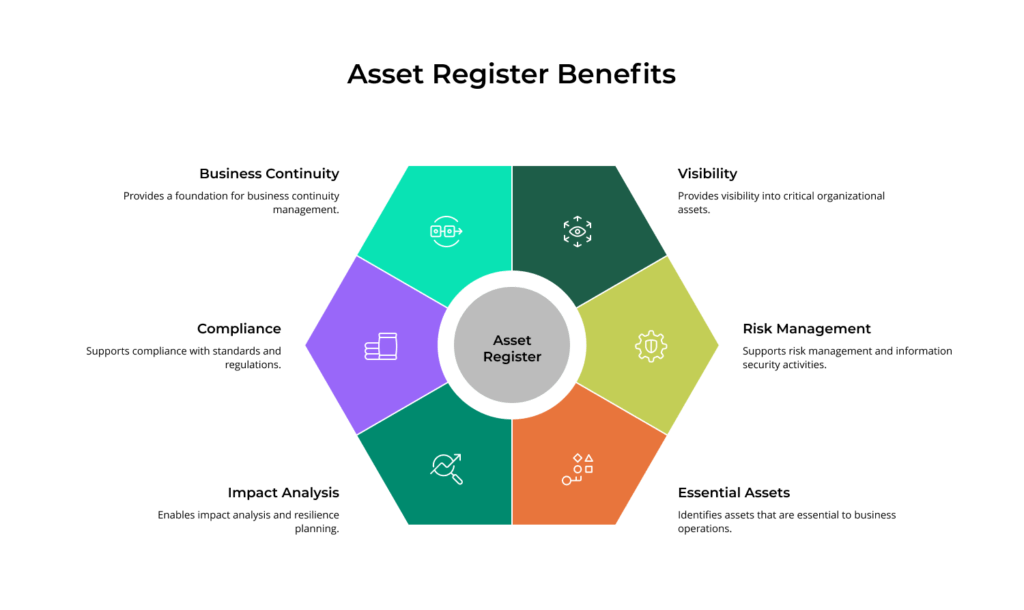
- providing visibility into critical organisational assets,
- supporting risk management and information security activities,
- identifying assets that are essential to business operations,
- enabling impact analysis and resilience planning,
- supporting compliance with standards and regulations,
- providing a foundation for business continuity management.
From a business continuity perspective, one of the greatest benefits of an Asset Register is its ability to connect assets with business processes. This view lets organisations determine which resources are truly critical to service delivery, what the consequences of their unavailability would be, and where resilience efforts should be focused.
The first step, however, is defining the scope of the register and identifying which assets should be included.
Which Assets Should Be Included in an Asset Register?
One of the most common mistakes organisations make is limiting the Asset Register to IT infrastructure.
When building an Asset Register, they often start by listing servers, laptops, applications and network devices. While these assets are important, they represent only part of the picture.
From a risk and business continuity perspective, an asset is any resource whose loss, compromise or unavailability could affect business operations or service delivery. A comprehensive Asset Register should therefore cover not only technology, but also information, people, processes, locations and third-party providers.
I recommend including the following categories:
| Asset Category | Examples |
|---|---|
| Information Assets | Customer data, financial records, technical documentation, intellectual property |
| Systems and Applications | ERP, CRM, manufacturing systems, business applications |
| IT Infrastructure | Servers, cloud environments, network equipment, workstations |
| Business Processes | Sales, manufacturing, logistics, customer service |
| Locations and Facilities | Offices, manufacturing sites, data centres, warehouses |
| Human Resources | Key specialists, operationally critical roles, employees with unique expertise |
| Suppliers and Third Parties | Cloud providers, IT vendors, logistics partners, subcontractors |
Many of these categories are directly connected. For example, an order fulfilment process may depend on an ERP platform, customer databases, a customer service team and an external logistics provider. If the Asset Register captures only the ERP system, the organisation gains only a partial understanding of the risk.
Many organisations have highly detailed inventories of their IT infrastructure but struggle to identify which business processes depend on those systems or which suppliers support critical services. Yet it is often these dependencies that determine the scale of an incident and the time required to recover.
For that reason, instead of asking, “What systems do we own?” ask, “What do we rely on to deliver our most important business processes?” This is a foundation of an Asset Register that supports not only asset management, but also risk management, business continuity and regulatory compliance.
What Information Should an Effective Asset Register Contain?
The real value of an Asset Register comes from context. Identifying assets is only the beginning. To support risk management, information security and business continuity, the register must provide meaningful business information about each asset.
Knowing that an organisation uses an ERP system or maintains a customer database is useful. Understanding who owns those assets, how critical they are, which processes depend on them and what would happen if they became unavailable is far more valuable.
We occasionally encounter organisations with extremely detailed technology inventories that still cannot answer fundamental business questions:
- Who owns this asset?
- Which business processes depend on it?
- How critical is it to service delivery?
- What would be the impact if it failed?
Without this information, even the most comprehensive inventory has limited practical value. A basic Asset Register should contain information such as:
| Asset | Owner | Classification | Criticality | Business Process | Status |
|---|---|---|---|---|---|
| ERP System | Chief Operating Officer | Confidential | Critical | Production Management | Active |
| CRM Platform | Sales Director | Internal | High | Sales Operations | Active |
| Customer Database | Commercial Director | Confidential | Critical | Customer Service | Active |
Each field serves a specific purpose. Ownership establishes accountability. Classification helps determine protection requirements. Criticality supports prioritisation during incidents and risk assessments. Business process mapping enables BIA activities and continuity planning.
As companies mature, the scope of information captured within the register often expands to include technical dependencies, service providers, availability requirements, service levels, associated risks and regulatory obligations. At that point, the Asset Register evolves from a simple inventory into a model of how the organisation actually operates.
Asset Classification and Criticality
Not all assets are created equal. The loss of a single employee’s laptop will have very different consequences from the failure of an ERP platform, an e-commerce system or a critical customer database. This is why determining asset criticality is one of the most important aspects of maintaining an effective Asset Register.
Despite this, many organisations still classify nearly every system as “important”. The consequences are easy to predict: when everything is treated as a priority, nothing truly is.
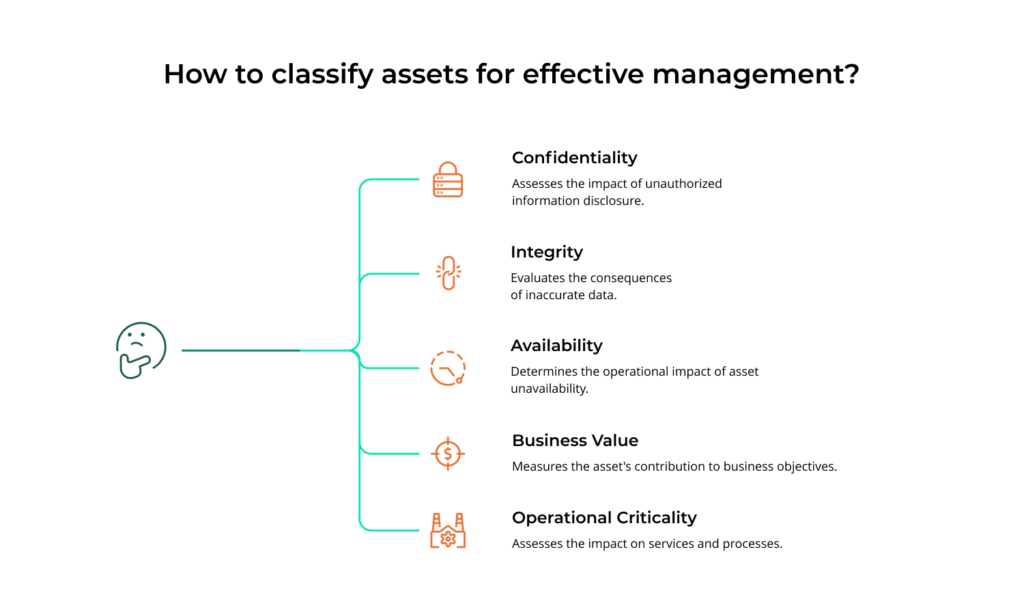
Asset classification helps organisations focus resources where potential business impact is greatest. Common classification criteria include:
- Confidentiality: what would happen if the information were disclosed without authorisation?
- Integrity: what would be the consequences of inaccurate or altered data?
- Availability: how long could the organisation operate without the asset?
- Business Value: how strongly does the asset support business objectives?
- Operational Criticality: what impact would its loss have on services and processes?
These criteria often produce valuable insights. A system may contain little sensitive information but still be operationally critical because multiple business processes depend on it. Conversely, a database containing highly sensitive information may require extensive protection even if a temporary unavailability wouldn’t disrupt business operations.
Effective classification encourages organisations to evaluate assets from a business perspective. It helps determine where security investments should be made, which recovery priorities are appropriate and where resilience measures will deliver the greatest value.
Asset Ownership: The Missing Piece in Many Registers
One of the most common weaknesses we encounter during Asset Register reviews is the absence of clearly defined asset ownership. Organisations can usually identify systems, data repositories and business processes. However, determining who is responsible for their business significance, classification and ongoing governance is often much more difficult.
This challenge often stems from the assumption that technology assets belong exclusively to IT teams. This is not entirely true; while IT may manage and maintain a system, it is rarely best positioned to determine its business importance or acceptable level of risk.
Those decisions belong to the business.
For that reason, every asset should have a clearly assigned business owner responsible for:
- defining business significance,
- approving classification,
- participating in risk assessments,
- ensuring information remains accurate and up to date.
Without clear ownership, an Asset Register quickly becomes a technical inventory rather than a meaningful resilience and risk management tool.
Asset Registers as the Foundation of Risk Management
Effective risk management begins with a simple question:
“What are we trying to protect?”
Many organisations begin risk assessments by cataloguing threats. Ransomware attacks, infrastructure failures, human error and supplier outages are all valid concerns. However, identifying threats alone does not explain their potential business impact. That impact can only be understood when threats are connected to assets.
This is why the Asset Register serves as a foundation for risk management. It allows organisations to build a logical chain:
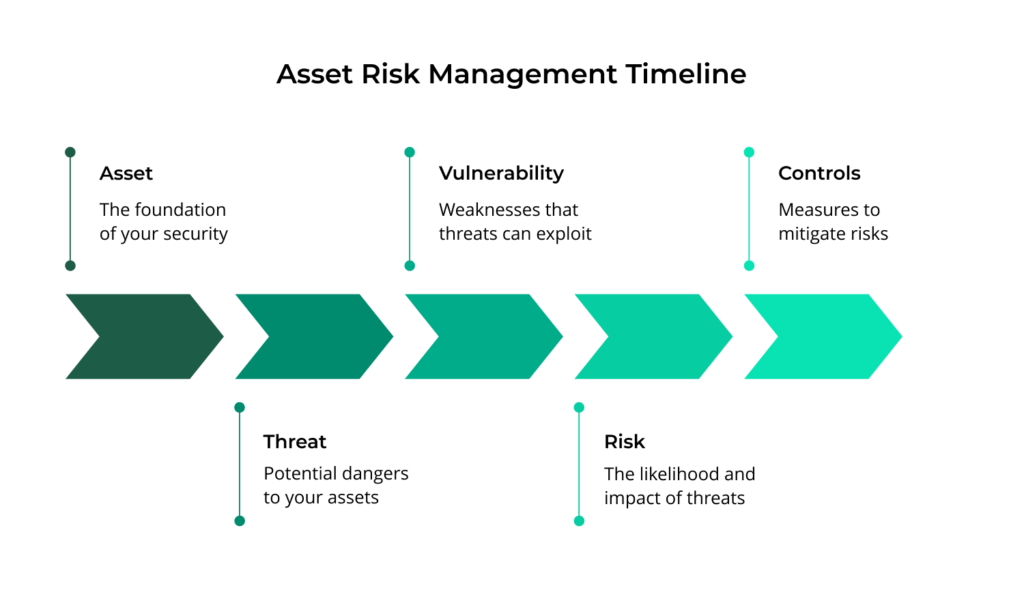
Consider a ransomware attack. The threat itself remains the same, but the consequences vary dramatically depending on which asset is affected.
An attack targeting a non-critical internal application may have minimal impact. The same attack affecting a customer-facing platform or critical operational system could significantly disrupt service delivery.
By linking risks to assets and their business importance, organisations can move beyond theoretical discussions about what might happen and focus on understanding what would actually be affected and how severe the consequences would be.
A well-maintained Asset Register therefore supports more informed risk assessments, stronger control selection and better decision-making based on real business impact.
Asset Registers in ISO 27001, NIS2 and DORA
All major security frameworks and resilience regulations assume that organisations understand the assets that support their operations.
- ISO 27001 requires organisations to identify and manage information assets.
- NIS2 focuses on protecting the services and resources that support essential and important entities.
- DORA places significant emphasis on operational resilience, critical ICT assets and dependency management.
Regardless of the framework, auditors and regulators often begin with a straightforward question:
“Show me your assets and explain which ones are critical.”
Without a reliable Asset Register, answering that question can be quite difficult.
Asset Registers and Business Continuity Management
An Asset Register is one of the most important components of an effective Business Continuity Management programme.
Business continuity initiatives typically begin with a Business Impact Analysis (BIA), which identifies critical processes and evaluates the consequences of disruption. However, knowing which processes are important is only part of the challenge.
Many organisations can identify their critical processes. What is often less clear is which assets those processes depend on. During continuity workshops, we often discover that a seemingly straightforward process relies on numerous systems, data sources, suppliers and specialist employees.
For example, an order fulfilment process may depend on:
- an ERP system,
- a customer database,
- an integration platform,
- cloud infrastructure,
- a logistics provider,
- key operational staff.
Without visibility into these dependencies, it becomes difficult to establish realistic recovery objectives, assess operational risk or develop effective contingency plans.
This is where the Asset Register becomes invaluable. It allows organisations to connect BIA results with the systems, data, people and third parties that support business operations. Business processes stop being abstract diagrams and become realistic operating models that reflect how services are actually delivered.
In our experience, organisations achieve the highest levels of BCM maturity when they stop analysing processes and assets separately. Combining BIA outputs with a well-maintained Asset Register creates a much stronger foundation for continuity planning and operational resilience.
Integrating Asset Registers with CMDB, GRC and ITSM
Asset Registers deliver the greatest value when they operate as part of a broader governance ecosystem rather than as a standalone database. Asset information supports numerous organisational activities, including risk management, business continuity, compliance, incident management and service operations.
Integration with CMDB, GRC and ITSM platforms is particularly valuable.
A CMDB (Configuration Management Database) provides detailed information about IT assets and technical dependencies. This information can serve as an important source of data for the Asset Register, particularly in complex technology environments.
GRC platforms use Asset Register data to support risk assessments, compliance activities, control management and resilience programmes. Within a GRC environment, asset information becomes part of a wider business context rather than remaining isolated within technology teams. This is the approach we took with our AdaptiveGRC platform.
ITSM platforms connect assets to operational processes such as incident management, change management and problem management. This enables organisations to understand how operational events affect business services and critical processes.
From a BCM perspective, the most valuable capability is the ability to connect assets with business processes, BIA results, continuity plans and recovery scenarios.
The most mature organisations establish a single, consistent data model in which asset information supports risk, resilience, compliance and IT operations simultaneously. This reduces information silos and creates a shared understanding of dependencies across the organisation.
Common Asset Register Mistakes
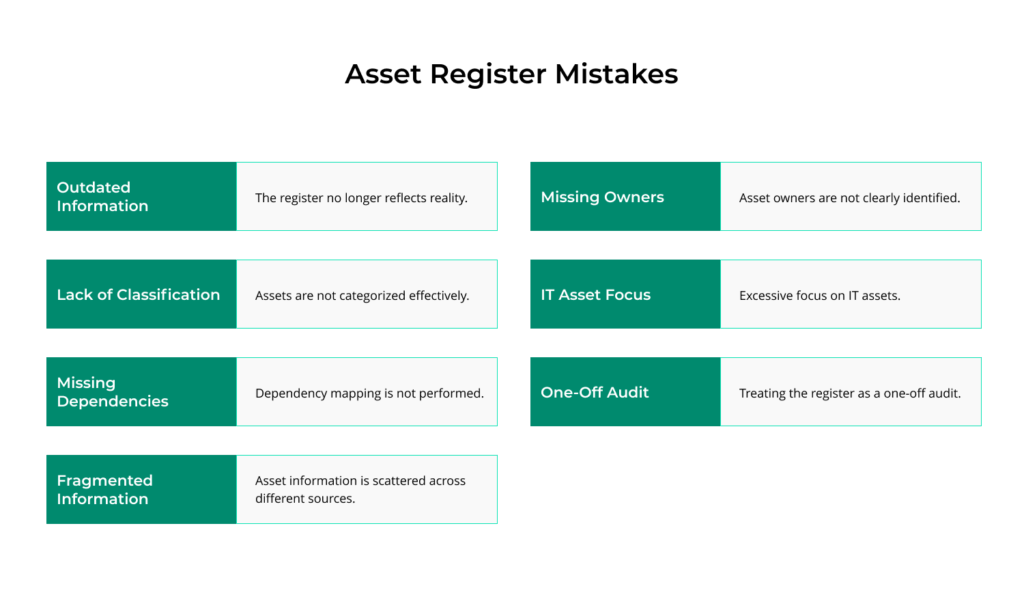
Many organisations maintain an Asset Register on paper but fail to gain meaningful value from it. The most common issue is this: the register simply no longer reflects reality. It might have done that right after implementation, but it’s no longer the case.
Common problems include:
- outdated information,
- missing asset owners,
- lack of classification,
- excessive focus on IT assets,
- missing dependency mapping,
- treating the register as a one-off audit exercise.
There is another challenge that frequently causes long-term problems: fragmented asset information.
Different departments maintain separate spreadsheets, databases and records. IT teams manage CMDBs, BCM teams maintain continuity documentation, security teams track critical assets and procurement teams maintain supplier records. Each source contains part of the truth. None provides a complete picture.
As a result, different teams work with different versions of reality, making it difficult to assess risk, understand dependencies and coordinate resilience efforts.
One of the primary goals of any Asset Register initiative should therefore be establishing a trusted, shared source of asset information across the organisation.
Building an Effective Asset Register: A Step-by-Step Approach
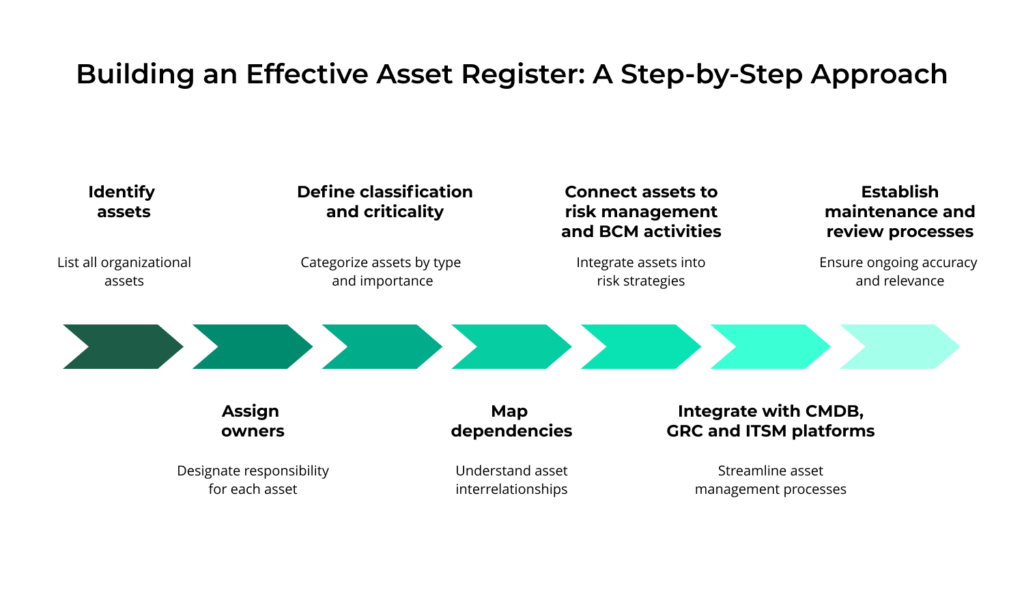
An effective Asset Register is usually developed iteratively:
- Identify assets.
- Assign owners.
- Define classification and criticality.
- Map dependencies.
- Connect assets to risk management and BCM activities.
- Integrate with CMDB, GRC and ITSM platforms.
- Establish maintenance and review processes.
At this point, I have to reiterate that creating the first version of an Asset Register is often the easiest part of the journey. The real challenge lies in keeping the register accurate and relevant months or years after implementation.
Best Practices for Maintaining an Asset Register
Even the most carefully designed Asset Register loses value if it fails to keep pace with organisational change. That’s why keeping the register up-to-date is crucial for long-term success.
Common best practices include:
- updating asset information through change management processes,
- conducting regular ownership reviews,
- automating data collection where possible,
- using the register within BIA and risk assessment activities,
- integrating asset information with GRC, IT and operational systems.
The greatest benefits emerge when the Asset Register is no longer viewed as an audit requirement or regulatory obligation. Instead, it becomes a shared source of information used by business, security, BCM and IT teams to support decision-making and strengthen organisational resilience.
How AdaptiveGRC Supports Asset Management and BCM
Within AdaptiveGRC, the Asset Register is integrated directly into the Business Continuity Management module and connected with risk management and broader GRC activities.
This enables organisations not only to maintain an up-to-date inventory of assets, but also to map dependencies, identify critical resources and use asset information throughout risk assessments, business continuity planning and compliance activities.
Rather than maintaining separate spreadsheets and disconnected repositories, organisations can build a unified view of the assets, processes and services that support their operations.
If you would like to see how an integrated approach to asset management can strengthen operational resilience, contact us or schedule a demo.