


The path to excellence is made up of small steps. The PDCA (Plan-Do-Check-Act) cycle is one of the best-known and most successful models for how these steps should be taken.
What is PDCA (Plan-Do-Check-Act)?
PDCA is an iterative model of continuous improvement, which aims to optimise processes, enhance quality, and boost operational efficiency, while limiting the risk associated with change and potential wrong solutions. The acronym stands for the four stages of the cycle: Planning, Doing (or executing the plan), Checking the results, and Acting on the results (or Adjusting the solution if need be). Importantly, this is not a schema for project design (although it can be applied to project management) but rather a continuous, iterative loop aiming for gradual improvement.
History and Significance of the Deming Cycle
The model was originally developed by Walter Shewhart and later perfected and popularised by W. Edwards Deming, an American statistician, engineer, and management consultant widely recognised as the father of the global quality movement. The Deming Cycle is one of the foundations of modern Quality Management and Quality Control philosophies. What Deming postulated, which might seem obvious but is indeed to this day contested by some top executives, is that business decisions should be driven by systematic processes and hard data analysis rather than intuition. Deming recognised that the path to predictable business excellence lay not in individual managerial genius, but in consistently applied, repeatable and testable methodologies. In a way, it is an adaptation of the scientific method to the needs of business management. One of the important outcomes of this approach is to move from assigning blame for mistakes to treating them as opportunities for optimisation. Occasional wrong turns are to be expected and the PDCA model is designed to limit their impact and take advantage of what can be learned from them.
The Four Stages of the PDCA Cycle – Step-by-Step
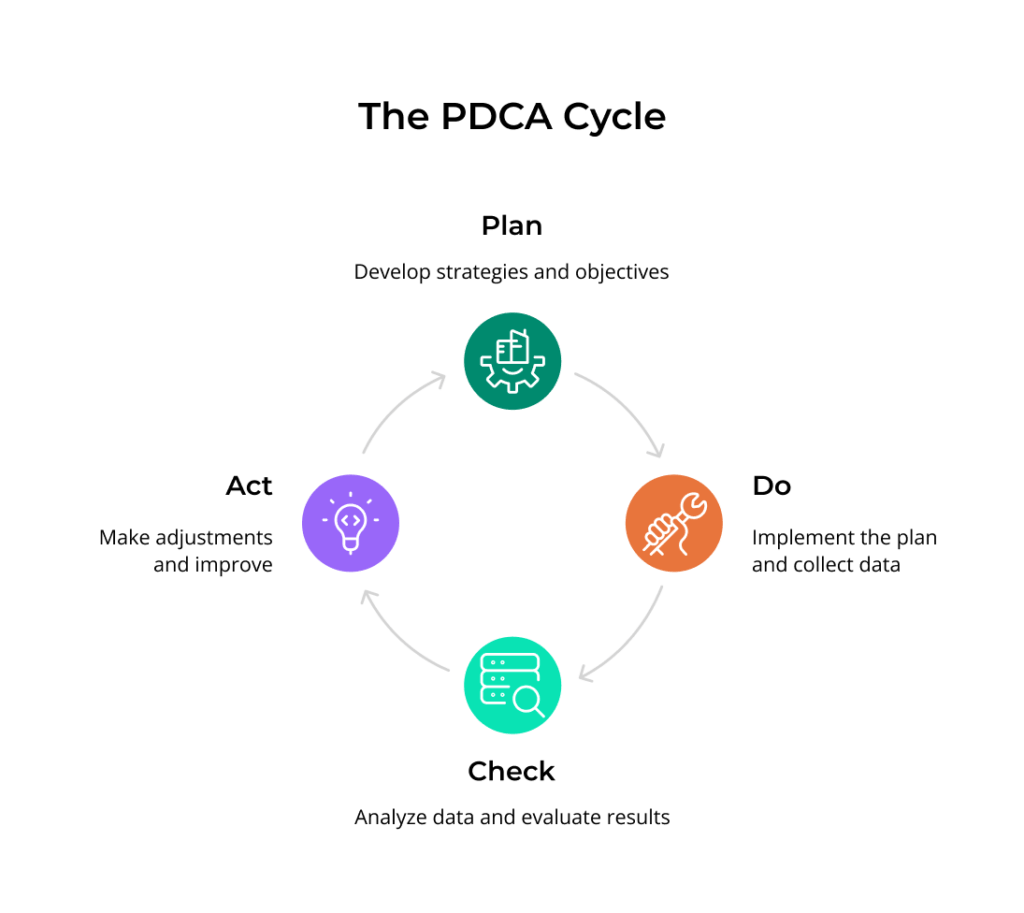
As mentioned, the acronym PDCA stands for the four stages of the Deming Cycle: Plan-Do-Check-Act. This is meant to form a logical four-step structure, where each stage transitions smoothly from one to the other. Data produced at each stage is used in the next stage to ensure objective decision-making. Importantly, this is a continuous circular process, so after the action stage, we move back to the planning stage.
Plan – How do you Define Objectives and Action?
The planning phase focuses on identifying the core problem to be addressed and conducting an analysis to find its root cause. Teams establish clear, measurable targets and design a detailed action plan to achieve them. This involves mapping out the resources, timelines, and responsibilities needed to implement the solution. It should be noted that it is typical for the PDCA method to attempt small, gradual improvements, rather than sweeping changes across the company. Thus, the planning stage will also often involve selecting a part of the organisation where the pilot project will be conducted.
Do – How do you Implement Changes in Practice?
Following from the above, it is strongly recommended that the proposed changes be tested on a small scale first. This is what the “doing” step involves – executing the action plan and implementing the proposed changes, initially in a small-scale deployment. This minimises operational risk and protects the organisation from costly, widespread mistakes. Thus, the outcomes of the pilot will provide useful insights to be used at further stages, regardless of its success.
Check – What is the Role of Data Analysis and Evaluation?
This is the phase for monitoring the real-world results of the pilot project. Did it succeed? What were the actual outcomes of the pilot project? It must be stressed that the activity of “checking” relies on rigorous data analysis, which allows the team to compare actual outcomes against the original goals set in the planning phase. This lets them objectively answer whether the implemented changes successfully resolved the problem.
Act – Standardisation and Continuous Improvement
If the pilot is successful, the company can move to the action or implementation stage. The new process is standardised and rolled out across the entire organisation. If the results are not satisfactory, the team adjusts the plan and restarts the cycle. That is why it is sometimes said that the “A” stands for “adjustment.” This stage ensures that successful improvements become the new baseline company standard.
How Does the Continuous Improvement Cycle Work?
As mentioned before, the Deming cycle functions as a permanent feedback loop of process optimisation that never truly stops. If the results of the pilot programmes are not satisfactory, the process loops back to the planning stage, where a new pilot project is designed and implemented in the “Do” stage. If it is successful, upon completion of the Act phase, it becomes a new standard. This immediately becomes the baseline for the next Plan phase, where either a further improvement to the same aspect is devised, or the team moves to another aspect of the organisation’s functioning. This repetitive momentum builds a mature corporate culture focused on long-term, incremental growth.
What are the Applications of PDCA in Organisations?
PDCA is a highly versatile tool used in process management, project management, and corporate safety. It is widely used in manufacturing, as well as modern Governance, Risk, and Compliance management, to ensure that organisations align with expectations. Companies deploy it to continuously optimise service delivery, streamline product development timelines, and proactively manage workplace health and safety hazards. Platforms like AdaptiveGRC leverage this exact structure to deliver scalable risk and compliance solutions.
What does PDCA have to do with ISO Standards?
The Deming Cycle lies at the base of many quality management standards. For instance, the ISO 9001 standard, which is the global benchmark for Quality Management Systems (QMS), maps neatly onto the PDCA schema. The Plan phase is leadership and planning; Do encompasses support and operations; Check covers performance evaluation; and Act governs continuous improvement. After all, the ISO 9001 certificate is not granted for providing high-quality service but for implementing a functioning system of assuring continuous improvements in quality – exactly what the Deming cycle intends to achieve. Similarly, the ISO 27001 for Information Security Management and ISO 22301 for Business Continuity Management Systems require an ongoing strategy for security management. PDCA is the backbone of such a system, which ensures that threat vulnerabilities are regularly checked and patched.
What are the Benefits of Implementing PDCA?
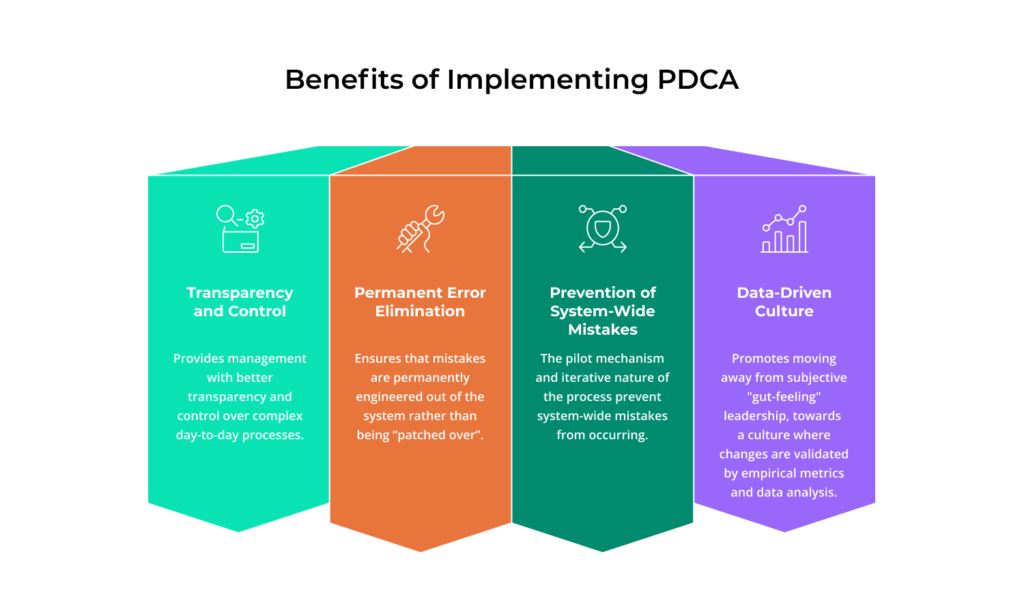
By breaking complex workflows down into four visible, manageable steps, it provides management with better transparency and control over complex day-to-day processes. Because the PDCA framework relies heavily on investigating root causes rather than treating superficial symptoms, it ensures that mistakes are permanently engineered out of the system rather than being “patched over.” At the same time, the pilot mechanism and iterative nature of the process prevent system-wide mistakes from occurring. Finally, it promotes moving away from subjective “gut-feeling” leadership, towards a culture where changes are validated by empirical metrics and data analysis. Thus, the return on investment from optimisation efforts is not only durable but also measurable.
What are the Common Mistakes in Applying PDCA?
Mistakes in implementing PDCA are usually caused by skipping one of the steps in the cycle. Often, it would be the Check phase, when changes are adopted without measuring their impact. Teams might also cut corners at the planning stage, neglecting to ensure the plan is properly thought out, detailed, and structured. Or they might ignore the Do stage, immediately rolling changes out across the whole system before doing a pilot study. Finally, and probably most commonly, management will fail to institutionalize successful changes during the Act phase, which causes employees to slip back into old habits.
Another common, if less obvious, divergence from the Deming method is to make critical adjustments based on gut feelings or low-quality feedback, rather than utilising objective data analysis. Teams may implement changes that “feel right” without going through the proper planning process. Or they will rely on casual observation and loose employee feedback rather than measurable data at the Check stage. Both management and employees in some cultural settings might also oppose the implementation of measurably beneficial changes that “don’t feel right.”
How to Implement PDCA Step-by-Step
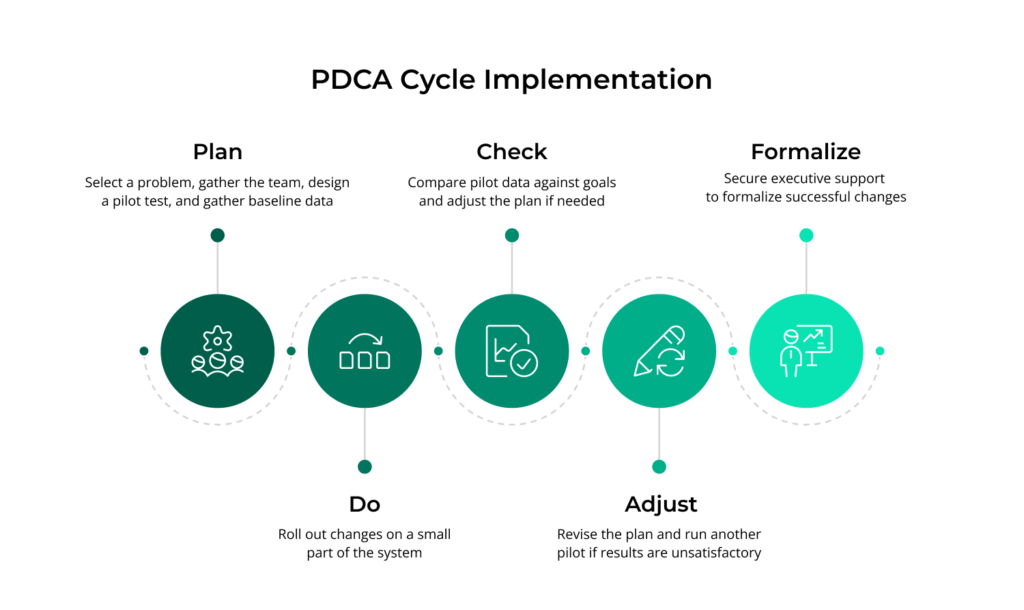
- Plan: Start by selecting a single, well-defined problem and gather the team closest to that workflow. Design a small-scale pilot test and gather baseline data before making any physical alterations.
- Do: roll the changes out on a small part of your system – one department, one machine, one outlet, etc.
- Check: Compare the data gathered in the pilot programme against your goals. If the results are unsatisfactory, go back to step 1 to Adjust the plan and run another pilot.
- Finally, if the results of the pilot study are satisfactory, secure executive support to formalise successful changes into official procedures.
What are some Real-World Examples of PDCA Implementation?
The PDCA cycle is successfully utilised in a number of industries. In manufacturing, it is used for production line optimisation to reduce waste and cycle times, to eliminate waste, lower defect rates, and – crucially – for quality control. Service and hospitality industries also rely on PDCA in Quality Management to boost customer satisfaction, systematically improve customer service quality, and shorten response times. IT departments leverage it to ensure continual cybersecurity and compliance with standards like ISO 27001, or by testing software patches on a small user group before full enterprise deployment.
Let’s look at a realistic scenario. An enterprise IT team reviews their security metrics and identifies a critical vulnerability: software patches are taking too long to be deployed across all the company’s computers. Plan: They set a goal to reduce critical patch deployment times to under 48 hours with automated patch deployment. Do: The team writes an automated patch deployment script and tests it on a small pilot group of laptops within the IT department itself. Check: They run automated compliance scans on the test laptops to check if the patches are installed correctly, verify that no systems crashed, and measure the exact deployment speed. Act: With the pilot successfully verified, the team schedules a company-wide rollout. They formalise the new script into their ISO 27001 compliance workflows and system maintenance schedules.
Summary: What is PDCA?
In the above example, the organisation avoided making massive, unverified changes based on guesswork. By planning carefully, testing small, checking the data, and standardising what worked, they successfully locked in continuous improvement. This is the essence of the PDCA cycle – repeatable, testable changes and data-driven, objectively measured results. It is not a one-time initiative or a checkbox exercise, but rather a permanent business philosophy, the strength of which lies in its simplicity, making it accessible to teams across all levels of an organization. Consistent use of the Deming Cycle ensures that an enterprise remains agile, efficient, and – as a result – competitive.