

The quality of your products and services has a direct impact on customer trust and, in turn, on your bottom line. As an organisation grows, that quality becomes harder to maintain without a structured system that defines who is responsible for what, which procedures apply, and how their effectiveness is verified. A quality management system (QMS) addresses that need by organising the work of the company around clearly defined processes. It also helps meet the requirements of ISO standards, which in many regulated industries are a precondition for doing business. This article explains how a QMS works, how it supports compliance with the most important ISO standards, and what a successful implementation looks like.
What Is a QMS?
A quality management system is a structured framework through which an organisation plans and runs everything that affects the quality of its products and services, while continuously improving how that work is done. It brings together business processes and the procedures that describe them, along with the roles and tools needed to manage those processes. Its scope reaches from the design of an individual business process through ongoing document control to the analysis of nonconformities and the implementation of corrective action.
In most cases, a QMS is built on the requirements of ISO 9001, the standard that has set the international benchmark for quality management since 1987. The standard sets out what the system must deliver but leaves the form open. Each organisation designs its own process structure to fit its size and risk profile within the realities of its industry.
The defining element of a QMS is the PDCA cycle (Plan, Do, Check, Act), which organises work on every process across four sequential stages. PDCA appears in all modern ISO management standards and gives the system its capacity for continuous improvement, as each iteration raises the effectiveness of the underlying processes.
How Does a QMS Support Compliance With ISO Standards?
Every ISO standard sets out a body of requirements, and simply knowing them is not enough to achieve compliance. An organisation has to show that its processes genuinely meet those requirements in everyday work and that it can prove this during an audit. A QMS provides the framework in which the requirements of a standard map onto specific processes and roles, with the supporting documents kept alongside. The auditor verifying compliance finds policy and the evidence of its application in one place.
Modern ISO management system standards share a common structure and the same underlying logic. The requirements of ISO 9001, ISO 27001, and ISO 22301 are organised in parallel and use closely related terminology, which makes it possible to manage them within a single system. Documentation, audits, management reviews, and risk management can then run consistently across multiple standards at the same time.
Effective compliance management within a QMS rests on three pillars. The first is process standardisation, through which every recurring activity has a defined flow, an owner, and the evidence required to prove it has been carried out. The second is centralised documentation, which prevents the same procedure from existing in several different versions across departments. The third is monitoring, meaning the ongoing assessment of process effectiveness and the early detection of deviations before they grow into serious nonconformities.
Key ISO Standards Supported by a QMS
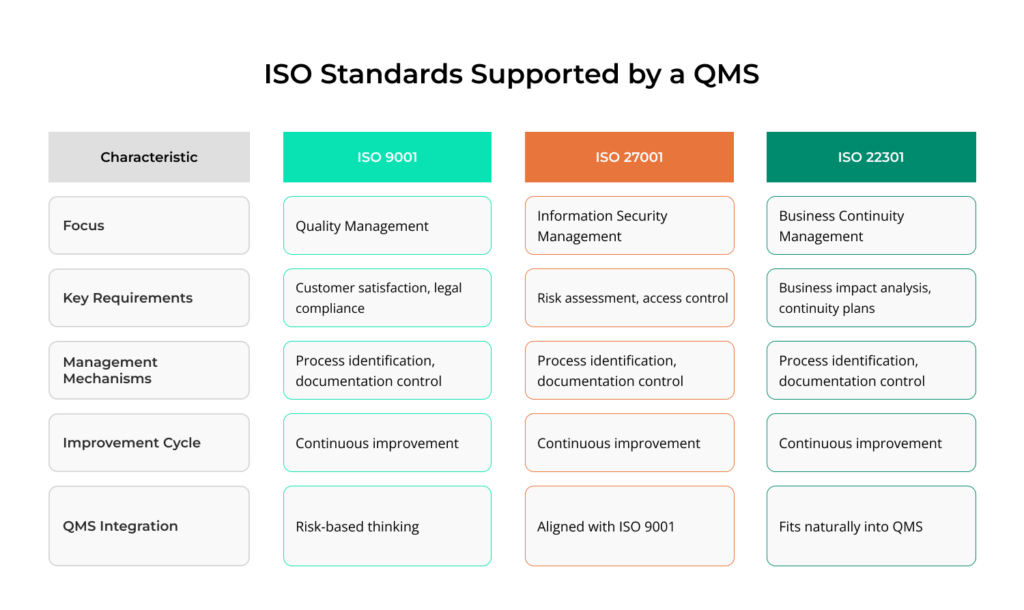
A QMS is not limited to product and service quality alone. Modern organisations need to look after information security and business continuity at the same time, and each of these areas has its own ISO standard. The QMS module from AdaptiveGRC makes it possible to address all of them through a single approach.
ISO 9001 is the oldest and most widely adopted quality management standard. It defines the requirements for a QMS and focuses on the ability of an organisation to deliver products and services that meet customer expectations and applicable legal requirements. The 2015 revision introduced risk-based thinking, which replaced the earlier preventive action requirements and tied quality management more closely to operational risk management.
ISO 27001 sets out the requirements for an information security management system (ISMS). Although it covers a different domain than quality, the management mechanisms align with those in ISO 9001. Both standards take the same approach to identifying processes, assigning responsibilities, controlling documentation, and running a continuous improvement cycle. A QMS makes it possible to handle internal audits, management reviews, and nonconformity management for both standards in a single environment.
ISO 22301 covers business continuity management (BCM). The standard requires, among other things, a business impact analysis, documented continuity plans, and regular testing. All of these are processes that fit naturally into a QMS structure. Repeated testing, review schedules, and nonconformity records are managed through the same mechanisms used for the other standards.
Document and Process Management in a QMS
Auditors look at documentation first, and it is most often the weakest point in a poorly organised company. A QMS gathers policy, procedures, work instructions, and records in a single repository with version control. Every document has an assigned owner, an approval path, and a date for the next review.
Processes within a QMS are described as sequences of actions with defined inputs and outputs, to which specific responsibilities and effectiveness measures are attached. A staff member running a process knows what steps to take, who approves the work, and what data to record. The manager responsible for the process has continuous access to current indicators and a full change history.
Linking documentation to processes solves a common problem in which procedures exist on paper while practice diverges from them. In a well-configured system, a change to a procedure forces an update of the related instructions, training materials, and audit records. Documentation stays current and reflects the actual state of the organisation.
Audits and Compliance Management
Every ISO standard requires regular internal audits. A QMS supports the process by managing the audit plan, the schedule, the checklists, and the records of findings. An internal audit carried out within a QMS environment follows a standardised procedure, with the findings flowing straight into the nonconformity register.
Identified nonconformities are then handled through the CAPA cycle of corrective and preventive action. The QMS tracks the status of every nonconformity from the moment it is reported, through root cause analysis, to the implementation and verification of the remedial action. The full history is available to the auditor at the next review and stands as evidence of systematic quality management.
Compliance management within a QMS environment also runs continuously between scheduled audits. Process-related KPIs reflect the effectiveness of control mechanisms in real time. Any deviation from agreed values triggers a signal that allows the team to act before the matter becomes a nonconformity raised by an external auditor.
How Does a QMS Support Risk Management?
The 2015 revision of ISO 9001 introduced risk-based thinking, which proved to be one of the most significant changes in the standard’s history. Every organisation is now expected to identify risks and opportunities tied to each process and to manage them in a planned way. Risk management has become an integral part of quality management and reaches well beyond a specialised security function.
A QMS makes it possible to link risks to specific processes and controls. Each risk has an assigned owner, an assessment of likelihood and impact, and a defined treatment plan. The control mechanisms that limit the risk are documented alongside it, and their effectiveness is verified on a regular basis. As a result, risk assessment is no longer a one-off exercise but a constant part of operational management.
An organisation that already manages risk within its QMS finds it easier to take on additional standards. The same risk register can be used to meet the requirements of ISO 27001 for information security and ISO 22301 for business continuity. The same risk no longer ends up being identified again and again across different projects under slightly different names.
The PDCA Cycle and Continuous Improvement
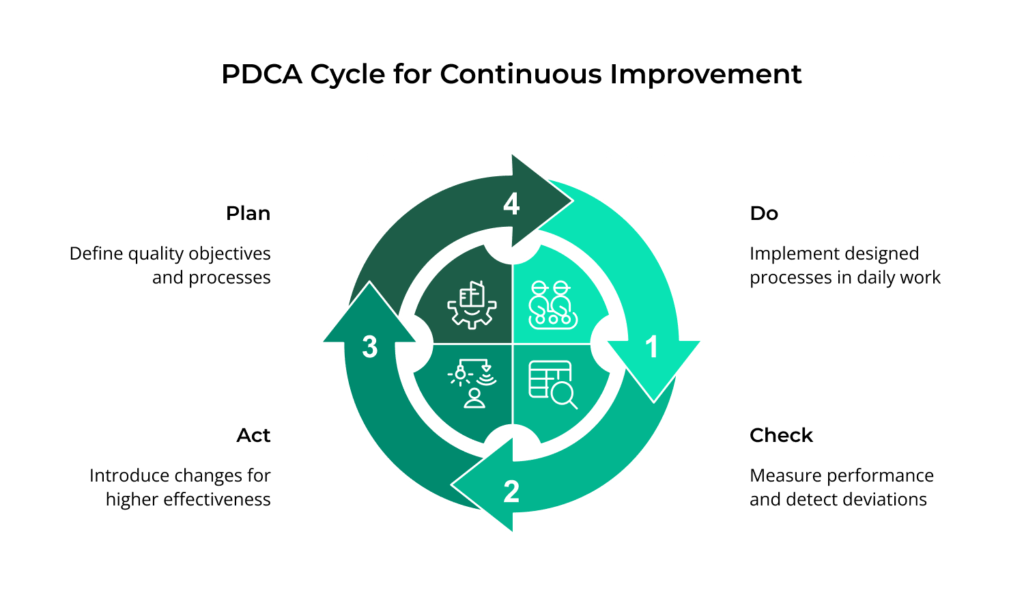
The PDCA cycle gives the QMS its momentum and sets it apart from a static set of procedures. In the planning stage (Plan), the organisation defines its quality objectives and identifies the processes that need to support them, then designs the relevant control mechanisms. This is when policies and procedures come into being, together with the measures that allow their effectiveness to be tracked.
The doing stage (Do) is the rollout of the designed processes in the daily work of the organisation. The checking stage (Check) covers the measurement of how well the implemented solutions perform, the analysis of indicators, and the detection of deviations. The acting stage (Act) closes the cycle by introducing the changes that the analysis suggests, so that the next iteration runs at a higher level of effectiveness.
The PDCA cycle operates on several levels at once. The whole organisation goes through it on an annual basis when it plans strategic quality objectives and reviews how they have been delivered. Individual processes are subject to it on a quarterly or monthly basis. Every nonconformity in turn triggers a PDCA cycle at the operational level. Applying the cycle across these levels delivers continuous improvement aligned with the seven quality management principles set out in the ISO 9000 series of standards.
Business Benefits of Implementing a QMS
The most immediate result of a QMS implementation is improved operational efficiency. Process standardisation removes unnecessary steps, reduces errors, and shortens delivery times. Teams know how to handle routine situations, while unusual problems have clearly defined escalation paths.
A second significant benefit is greater trust from customers and business partners. ISO 9001 certification is, in many sectors, a precondition for taking part in tenders or working with larger clients. In pharmaceuticals and the automotive industry, suppliers are routinely required to hold a certified QMS, and a similar expectation now applies in much of the financial sector. A certificate alone opens the door to market segments that remain closed to organisations without a formal quality management system.
A third benefit becomes visible whenever new regulation is introduced. An organisation with a QMS in place adapts to new legal requirements far more quickly. Processes required by NIS2 or DORA can be woven into the existing QMS structure without being built from scratch. Risk management and documentation are already in place, the compliance management routines work, and the implementation comes down to filling in the missing elements.
How Do You Implement a QMS Aligned With ISO?
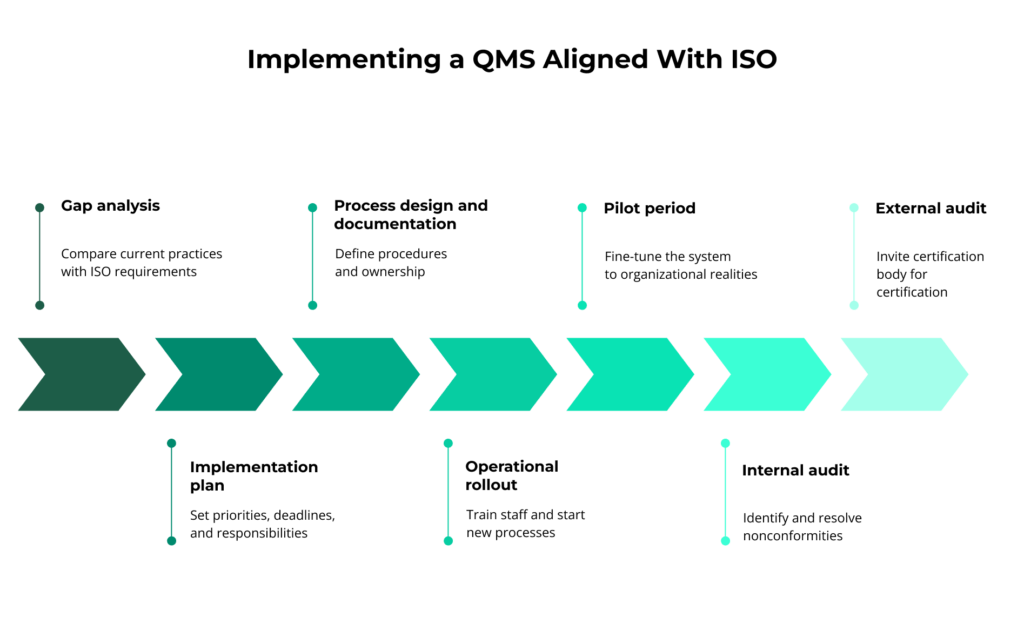
A QMS implementation begins with a gap analysis, a comparison of the way the organisation currently works against the requirements of the chosen standard. The analysis shows which processes already meet the requirements and which need to be designed from scratch or substantially reworked. On that basis, the organisation prepares an implementation plan that sets priorities and deadlines and assigns responsibilities for each task.
The next stage is process design and documentation. This is when the organisation has to decide how its procedures will look and who will own them. The most common mistake is to copy templates from the internet without describing the company’s own processes as they actually run. Procedures written by people who do not know the operational reality, with no input from those who do the work, fail their first audit and get ignored in daily practice.
Operational rollout covers staff training, the start of new processes, and a pilot period during which the system is fine-tuned to the realities of the organisation. The implementation finishes with an internal audit before certification, which allows any remaining nonconformities to be identified and resolved. Only then does the organisation invite a certification body to carry out the external audit.
Common Challenges and Mistakes
The first recurring mistake is a surface-level approach to documentation, in which procedures are produced solely with the audit in mind. Documentation that is detached from operational reality creates the appearance of compliance, yet at the first serious incident it becomes clear that staff do not know or do not follow the documented procedures. External auditors notice the gap faster than the organisation expects.
The second common challenge is the lack of genuine commitment from senior management. Clause 5 of ISO 9001 names leadership as a required element. A board that hands the QMS over entirely to a quality coordinator and only shows up for a ceremonial annual management review undermines the whole system. Staff read the signal quickly and treat the requirements as a bureaucratic exercise with no link to company strategy.
The third common challenge is a mismatch between the processes documented in the QMS and the way the organisation actually works. It appears when changes in operational practice are not reflected in the system documentation. After a year or two, the QMS starts describing an organisation that no longer exists. Regular process reviews and updates have to be part of the quality management calendar throughout the year, with particular attention paid to the periods between audits.