


An organisation can expose far more than its security inventory suggests. Domains, certificates, employee profiles, job adverts, public documents, code repositories and internet-facing services all reveal parts of its digital footprint. Each item may be harmless in isolation. Combined, they can help an attacker identify a weak point, impersonate a trusted person or prepare a convincing phishing message.
OSINT, or Open Source Intelligence, helps defenders examine that external view first. It brings structure to information gathering from open sources by adding validation, correlation and analysis. It can strengthen cyber threat intelligence, attack surface management, incident response and cyber risk management. It does not replace internal telemetry, penetration testing or vulnerability management. Its role is to show what can be learned about the organisation from outside.
What Is OSINT and Why Does It Matter in Cybersecurity?
Open Source Intelligence is the systematic collection and analysis of information available from public sources. These may include websites, search engines, public registers, social media, code repositories, technical indexes, vulnerability databases and archived content.
The word “intelligence” is important. Finding a result is not the same as understanding it. A useful OSINT investigation checks whether the information is current, credible and relevant. It connects separate observations and explains what they mean for a decision.
For example, identifying a subdomain produces a data point. Establishing that it hosts an unmanaged application, exposes an outdated service and has no confirmed owner turns that data point into a risk finding.
The importance of OSINT becomes clear when you consider how attackers work. Reconnaissance often starts with technologies, suppliers, staff roles, email patterns and external services. Public information reduces uncertainty and helps them tailor an approach.
Security teams can use the same view earlier. OSINT in cybersecurity may reveal forgotten infrastructure, lookalike domains, exposed credentials, sensitive metadata or secrets in a public repository. It can also add context during an incident.
The value lies in prioritisation, not volume. A verified signal should help the team decide what to secure, reset or investigate first.
How OSINT Analysis Works and Which Sources It Uses
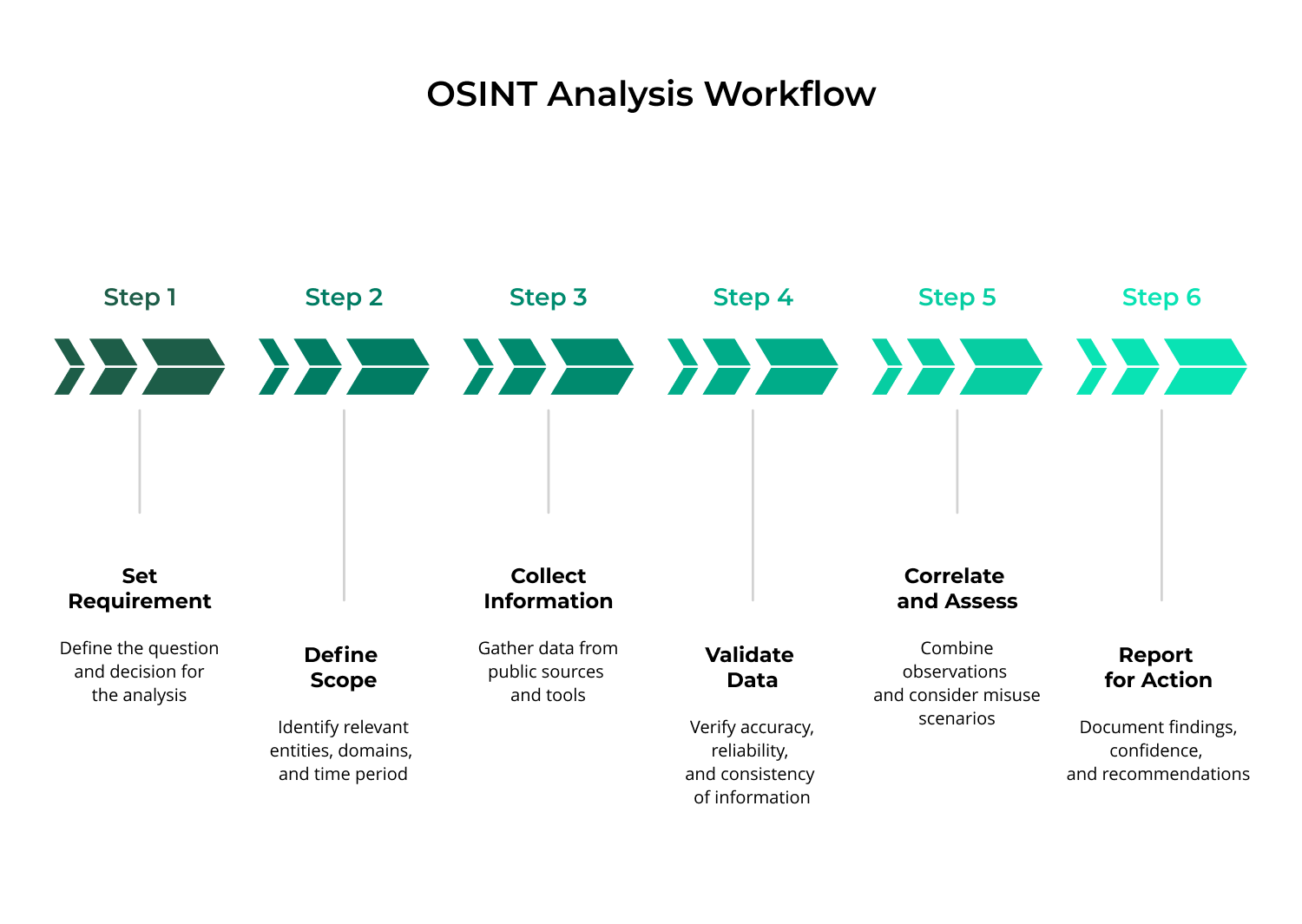
A reliable OSINT analysis follows a defined workflow.
1. Set the requirement. Start with the question the analysis must answer and the decision it should support.
2. Define the scope. Identify the relevant brands, entities, domains, IP ranges, technologies, people or time period. The scope should be approved and proportionate.
3. Collect information. Use search engines, public registers, technical datasets, APIs and specialised OSINT tools. Collection may be manual, automated or both.
4. Validate the data. Check dates, source reliability and consistency with other evidence. Public information can be incomplete, inaccurate or obsolete.
5. Correlate and assess. Combine related observations and consider the likely misuse scenario. A public service becomes more important when it is unmanaged, vulnerable or connected to a critical process.
6. Report for action. Record the evidence, confidence level, affected asset, risk owner, recommended response and review date.
The right sources depend on the question. Technical reviews may use DNS data, domain and certificate records, IP information and service banners. Social engineering assessments may focus on corporate websites, profiles, recruitment adverts and public documents.
Code repositories may expose environment names, hostnames, API endpoints, tokens or keys committed by mistake. Web archives can show information removed from a live site.
No source should be conclusive on its own. Search results may be stale, automated detection may be wrong, and breach records may be misattributed. Material findings should be checked elsewhere.
OSINT for Attack Surface Management: Domains, Assets and Leaks
Attack surface management asks two practical questions: what is exposed to the internet, and is every exposed asset known and controlled? OSINT techniques help answer them beyond the limits of an internal asset register.
The analysis may cover domains, certificates, public services, cloud assets, test environments and supplier-operated systems. It can also reveal shadow IT outside approved processes.
Because the external footprint changes continuously, regular monitoring usually delivers more value than an annual snapshot.
Gartner’s research on attack surface management states that assessing the visible attack surface and correlating findings with threat intelligence and vulnerability data are critical to prioritising remediation. OSINT can provide part of the external evidence needed for that assessment, particularly information about assets and signals visible from outside the organisation.
Within attack surface monitoring, domain analysis can identify forgotten subdomains, misconfigured records and names resembling the organisation. Lookalike domains may support phishing or impersonation.
Similarity alone is not proof of malicious activity. Confidence increases when the domain hosts copied branding, sends email or appears alongside other campaign indicators. The process should define when to monitor, investigate or escalate.
Exposure monitoring may show that corporate emails, passwords, tokens or documents have appeared outside an approved environment. A match may be old, duplicated or linked to a third party.
The team should check whether the account still exists, whether a password may have been reused, or whether a token remains valid. The response may include resetting credentials, revoking keys, reviewing logs or opening an incident.
The attack surface also includes information about people and processes. Names, projects, suppliers and technology references can help attackers build a credible pretext.
Defensive OSINT should not police employees. Its purpose is to identify organisational patterns of exposure, such as public document templates, approval routes or meeting identifiers. These findings can strengthen training by using realistic scenarios rather than generic warnings.
OSINT for Cyber Risk Management, Threat Intelligence and Incident Response
OSINT for cyber risk management is useful only when findings enter an established governance process. Each material observation should be linked to an asset, threat scenario, owner and treatment action. Otherwise, it remains an interesting fact rather than managed risk.
Open-source information can enrich supplier due diligence, validate external exposure and help prioritise remediation. It should not be the sole basis for a high-impact decision. A public signal requires verification, while the absence of a signal does not prove that risk is low. The process should distinguish possible exposure from confirmed exposure.
The same material can support cyber threat intelligence and incident response. Cyber threat intelligence turns threat data into context for decisions, while OSINT can add information about domains, IP addresses, certificates, attack techniques and relationships between campaigns.
During incident response, open-source data can enrich indicators and identify related infrastructure. Analysts should separate external assessments from internally confirmed evidence and state what is known, assessed or still hypothetical.
This distinction supports faster action without overstating certainty.
OSINT Tools: Selection, Limitations and Good Practice
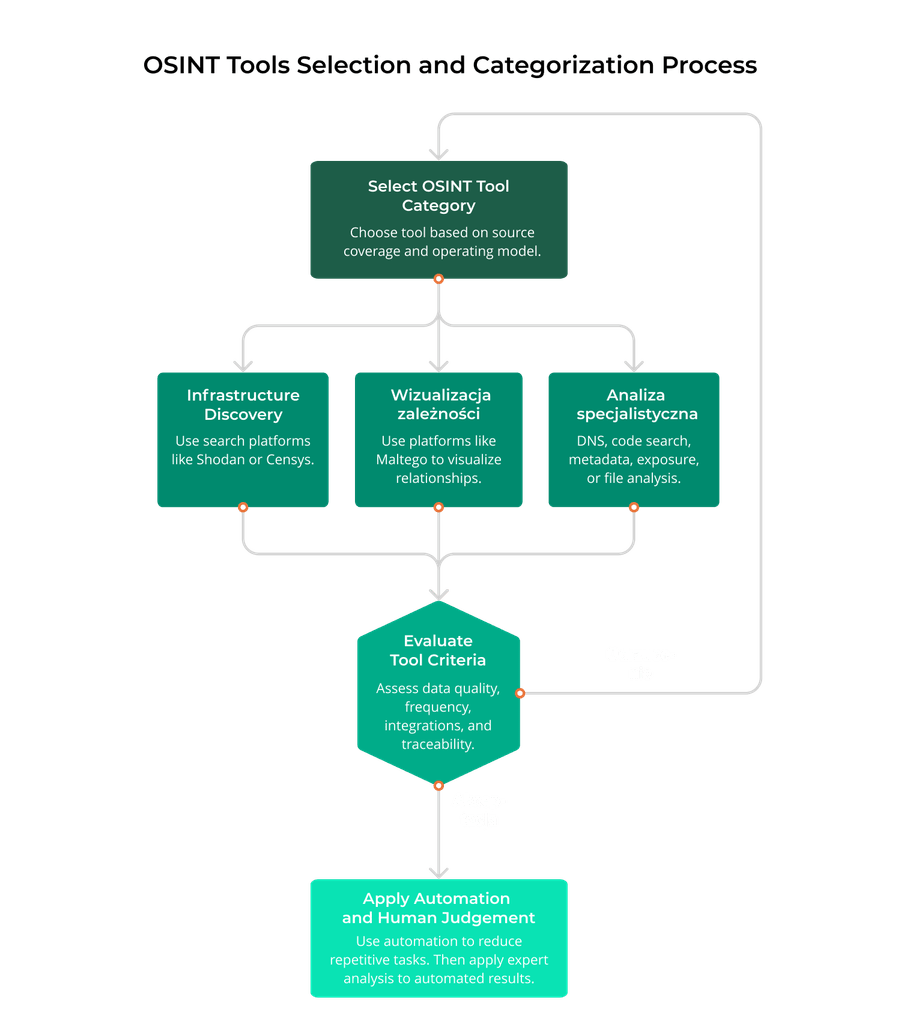
No single platform provides a complete view. OSINT tools should be selected according to the intelligence requirement, source coverage and operating model.
Internet search platforms such as Shodan and Censys can support infrastructure discovery. Shodan indexes publicly available information about internet-connected devices and services. Censys structures information on hosts, web properties, services and certificates. Link-analysis platforms such as Maltego help investigators connect observations from multiple sources and visualise relationships.
Other categories include DNS tools, code search, metadata analysis, exposure monitoring and file analysis. Selection should consider data quality, update frequency, integrations, access controls and source traceability. Automation reduces repetitive work, but it does not replace judgement.
OSINT, NIS2, ISO/IEC 27001 and DORA
NIS2, ISO/IEC 27001 and DORA do not require a specific OSINT product. OSINT can nevertheless support activities expected within these frameworks, including risk identification, threat monitoring, vulnerability management, incident handling and supplier oversight.
NIS2 establishes cybersecurity risk-management and reporting obligations for organisations in scope. ISO/IEC 27001 defines requirements for an information security management system and places risk management at its core. DORA has applied since 17 January 2025 and focuses on digital operational resilience in the financial sector.
OSINT findings may feed a risk register, support an incident assessment or demonstrate that an external monitoring process is operating. Buying a tool is not evidence of compliance. Compliance depends on governance, accountability, documented processes and effective controls.
Tool selection does not remove the method’s limitations. Public information may be outdated, duplicated, misattributed or removed from context. A hostname may belong to a supplier, and a breach record may contain an address never used for corporate access.
Passive information gathering should be separated from active testing, which may require explicit authorisation. Teams should define the purpose and scope, record sources, control access and verify material findings. Results should move into incident response or risk workflows with an owner and target date. OSINT works best as a maintained process, not a one-off exercise.
How to Assess Your Own Cyber Exposure with OSINT: Key Takeaways
Begin with one brand, domain or critical service. Compare known assets with what an external observer can discover. The gap often reveals the first priorities.
Next, classify findings by potential impact and urgency. A public contact address is not equivalent to a valid credential. An old subdomain is not equivalent to an unmanaged service supporting a live process. Priority should reflect the plausible misuse scenario.
Finally, set the review frequency, owners and measures, such as validation time, remediation rate and false-positive rate.
OSINT shows what an external observer can learn about your organisation without accessing its internal systems. That perspective can reveal unmanaged assets, leaked data, impersonation infrastructure and information that supports social engineering.
The value of Open Source Intelligence does not come from using the largest number of tools, but from asking precise questions, validating sources and connecting each finding to a decision.
The strongest approach is continuous and proportionate. When OSINT is integrated with cyber risk management, threat intelligence and incident response, open information becomes an input to resilience rather than another stream of unactioned alerts.