

ISO 9001:2026 represents the most significant update to the quality management standard in more than a decade. The revision strengthens the role of leadership, expands the approach to risk management, formalises knowledge and information management, and further aligns quality management systems with real business decision-making. Organisations certified under ISO 9001:2015 will be granted a three-year transition period, but preparation should begin well in advance to avoid costly and disruptive changes shortly before certification audits.
Every revision of ISO 9001 is a response to changes that have already taken place in the way organisations operate. The objective is not merely to make editorial improvements to the standard but to align its requirements with evolving business, regulatory, and technological realities. This is precisely how ISO 9001:2026 should be viewed. The draft is currently at the Draft International Standard (DIS) stage, an advanced phase of international consultation and review.
For organisations operating in regulated industries, the new version of the quality standard carries particular significance. Quality management systems are increasingly becoming part of a broader governance framework that includes risk management, regulatory compliance, internal audit, and information security. ISO 9001:2026 clearly reinforces this direction, which for many organisations will require rethinking the role of the QMS within their overall management model.
What Is ISO 9001?
ISO 9001 is an international standard that specifies requirements for a Quality Management System (QMS). Developed by the International Organisation for Standardisation, it has remained one of the most widely implemented management standards worldwide for decades. Its versatility allows it to be applied by both small service providers and multinational corporations operating across multiple jurisdictions.
ISO 9001 provides a framework for managing process, product, and service quality without prescribing how organisations should operate. The standard is based on the process approach and the PDCA (Plan-Do-Check-Act) cycle, emphasising the importance of planning activities, implementing them effectively, monitoring outcomes, and continuously improving performance. At the same time, strong emphasis is placed on customer focus and the proactive management of risks and opportunities.
Why ISO 9001 Matters for Organisations
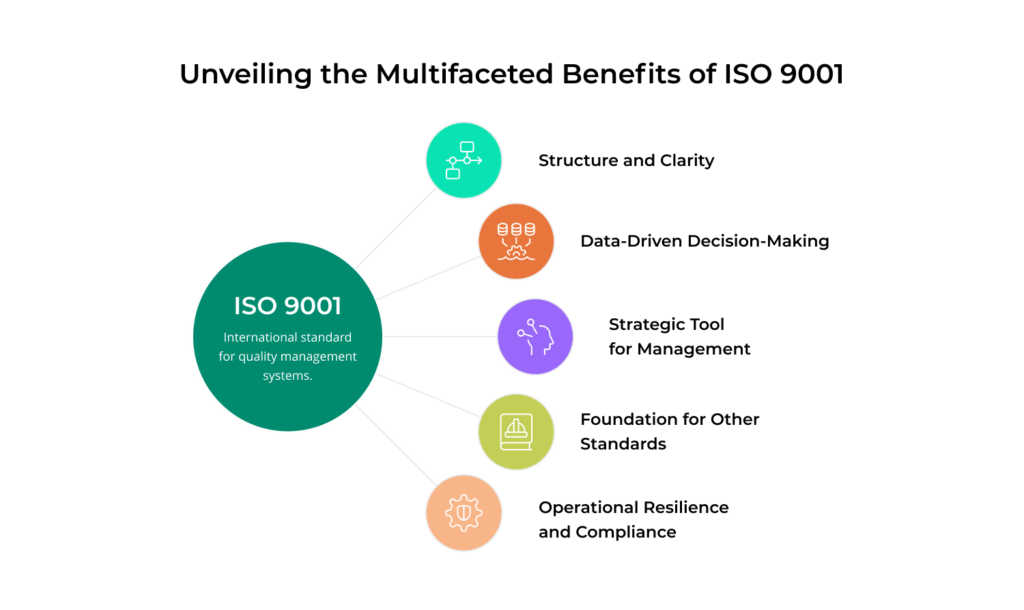
The value of ISO 9001 extends far beyond obtaining a certificate. In practice, a well-designed and properly maintained quality management system brings structure to organisational operations, clearly defines responsibilities, and supports data-driven decision-making rather than reliance on intuition.
For management teams, a QMS can become a strategic tool that helps identify where problems originate and which processes genuinely influence customer satisfaction. Furthermore, ISO 9001 often serves as the foundation for implementing additional standards and regulatory frameworks. Organisations with mature quality management systems typically find it easier to integrate requirements from ISO 27001, ISO 22301, NIS2, or DORA.
In this sense, ISO 9001 supports not only quality but also operational resilience and regulatory compliance across the organisation.
Why Does ISO 9001 Need an Update After 11 Years?
More than eleven years have passed since the publication of ISO 9001:2015, and the way organisations operate has changed dramatically during that time. Processes have become increasingly digitalised, teams often work in hybrid environments, and operational risks are now frequently technological or information-related in nature.
At the same time, regulators, customers, and auditors expect more than policy statements—they require objective evidence of effective management and governance.
In response to these developments, ISO initiated a revision of the standard, which is currently in the Draft International Standard stage. According to the current roadmap, the final version is expected to be published in September 2026. As with previous revisions, organisations certified against ISO 9001:2015 are expected to receive a three-year transition period to adapt their systems without losing certification.
What Is New in ISO 9001:2026?
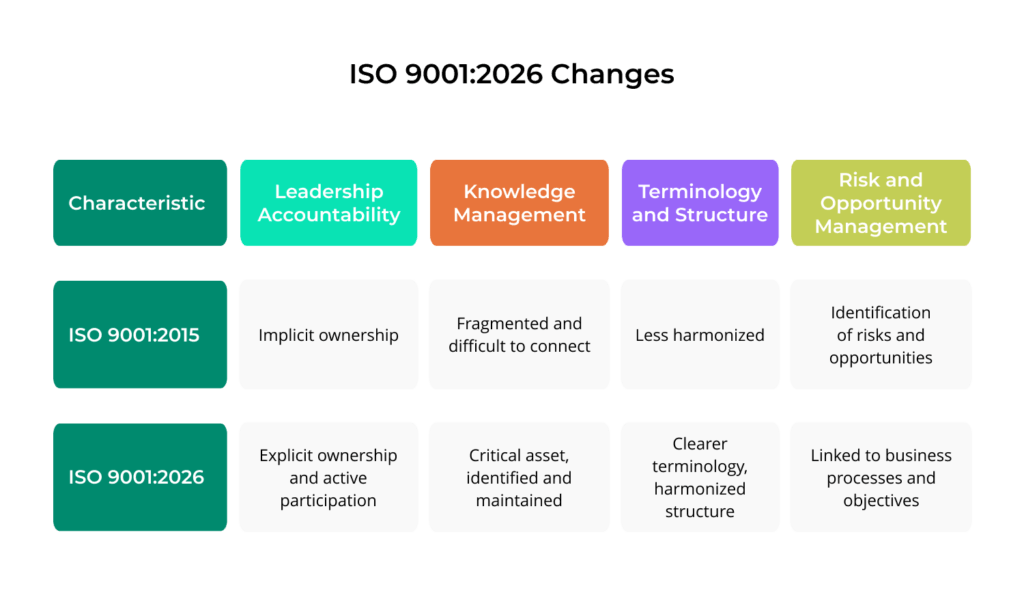
One of the most visible changes in ISO 9001:2026 is the stronger emphasis on leadership accountability. The standard explicitly expects top management not only to formally own the quality management system but also to actively participate in decisions regarding its effectiveness and development.
In practice, leadership teams will be expected to play a more active role in setting priorities, allocating resources, and ensuring that quality initiatives support business goals.
Organisations will need better visibility into how knowledge is created, maintained, and shared across the business. In practice, many organisations possess vast amounts of documents, procedures, and data that are fragmented, outdated, or difficult to connect with specific processes. ISO 9001:2026 strengthens requirements related to identifying, maintaining, and updating organisational knowledge, recognising it as a critical asset for quality management.
The revision also introduces clearer terminology and aligns more closely with the harmonised structure used across ISO management system standards, making integration with other frameworks significantly easier.
Finally, the treatment of risks and opportunities becomes more mature and practical. Organisations will be expected not only to identify risks and opportunities but also to demonstrate how they are linked to business processes, quality objectives, and corrective actions.
What Will Remain Unchanged?
Despite the scope of the revision, ISO 9001:2026 does not abandon the core principles that have long defined the standard. The PDCA cycle remains the foundation of quality management, as do the process approach and customer focus.
Organisations that already monitor their processes effectively and use performance data to drive improvement will not need to redesign their QMS from scratch.
Compatibility with other ISO standards will also be preserved, reinforcing the ongoing trend toward integrated management systems. As a result, investments made in developing quality management systems over recent years will continue to provide value and serve as a solid foundation for compliance with the new version of the standard.
How Can Organisations Prepare for ISO 9001:2026?
Preparation should begin with a comprehensive gap analysis comparing the existing quality management system against the requirements outlined in the DIS draft. Such an assessment helps organisations identify which areas require minor adjustments and which may demand more substantial organisational or technological changes.
Particular attention should be paid to leadership involvement, knowledge management practices, and the organisation’s approach to risk management.
The next step involves reviewing and updating quality documentation, policies, and procedures. As information consistency and currency become increasingly important under the new standard, manual document management approaches are likely to become insufficient.
Organisations should also invest in employee training and secure active engagement from senior management. Without genuine leadership involvement, a QMS risks remaining a formal compliance exercise disconnected from day-to-day business decision-making.
The Role of Digital Tools in a Smooth Transition
Many organisations are discovering that spreadsheets and fragmented file repositories are no longer capable of supporting a modern quality management system effectively. Issues related to document version control, accountability, action tracking, and management reporting often become particularly visible during audits.
As a result, quality management systems are increasingly operated as part of broader Governance, Risk, and Compliance (GRC) platforms. Solutions such as AdaptiveGRC’s Quality Management module enable organisations to work from a single source of truth, automate reviews, assign process ownership, and monitor nonconformities in real time.
This approach transforms ISO 9001 from an isolated management system into a practical tool that actively supports risk management and regulatory compliance across the entire organisation.
FAQ
Conclusion
ISO 9001:2026 is more than just another revision of a familiar standard. It signals a broader shift in how organisations are expected to approach quality management. Companies that start preparing early will have more time to strengthen processes, close compliance gaps, and align quality management with broader governance and risk management activities.
Rather than treating compliance as the primary objective, organisations should use the transition to build a quality management system that delivers measurable business value, supports strategic decision-making, and integrates seamlessly with broader governance, risk, and compliance initiatives.