

Every organisation lives with uncertainty, but not every organisation manages it well. Risk assessment is the discipline that turns a vague worry about “what could go wrong” into a structured, defensible plan of action. In a world of tightening regulation and rising cyber threats, it has become a core part of good risk management rather than a box-ticking afterthought. This article explains what risk assessment is, why it matters, and how the process works, from identification through to treatment.
From Guesswork to Governance: What Is Risk Assessment?
Let’s start with the basic definition. What is risk assessment really? In short, it is a structured process of identifying, analysing and evaluating risks that could affect an organisation. The stress here is on ‘structured process’ — it’s not supposed to be based on intuition alone. The point of the whole exercise is to understand the level of risk the organisation faces and make informed decisions about how to deal with it. So now the obvious question is: what is ‘risk’ in risk assessment? ISO 31000, the international standard for risk management, defines risk as “the effect of uncertainty on objectives.” The interesting thing about this definition is that it treats risk as two-sided; after all, uncertainty can have negative but also positive effects on objectives. For instance, the volatility of the oil market is a huge potential negative for any transport venture, but it’s been a boon for oil companies and electric car producers. Notice also that risk is framed against objectives, not just as “something bad happening.” This offers a tighter framing, showing what is actually at risk.
Once the risks have been defined, decisions must be made about how to address them. This makes risk assessment a subset of the wider risk management process. Risk assessment itself can be said to be composed of risk identification (i.e. finding risks) and risk analysis (i.e. sizing them up — deciding how severe they are). The third stage of the whole identify-analyse-evaluate cycle is deciding how to deal with the risks.
Know Your Risks Before They Strike: Why Does Risk Assessment Matter?
“Vibe coding” with AI doesn’t always work, vibe budgeting almost never does, and vibe-based risk management is quite certainly a terrible idea. While the intuition of an experienced manager is not to be disregarded, it is still better to back it up with hard data and analysis.
Risk assessment gives decision-makers the information they need to allocate resources and choose controls. It supports conscious, evidence-based decision-making and prevention rather than reacting blindly to problems after they happen. Without it, security and compliance spending is little more than guesswork.
In the long run, good risk assessment builds organisational resilience. It underpins regulatory compliance, and many frameworks require a documented risk assessment. In the short to medium term, it helps the organisation prioritise; not every risk can or needs to be addressed at once, and having good risk assessment data allows an organisation to determine which issues should be dealt with first and how to spend available security resources.
Risk assessment understood as a continual identify-analyse-evaluate loop is also needed because the risk environment is dynamic — both the threat landscape and the organisation itself are subject to change.
Finally, it makes business sense. Not only does it allow an organisation to avoid potentially costly problems, it also clearly connects risk to strategy and objectives. It makes risk visible and understandable to leadership, investors, and other stakeholders. This makes security and resilience spending easier to obtain and justify.
The Four-Step Loop: What Are the Key Stages of the Risk Assessment Process?
We have already mentioned the broad strokes of the risk assessment process; now we shall discuss it in more detail.
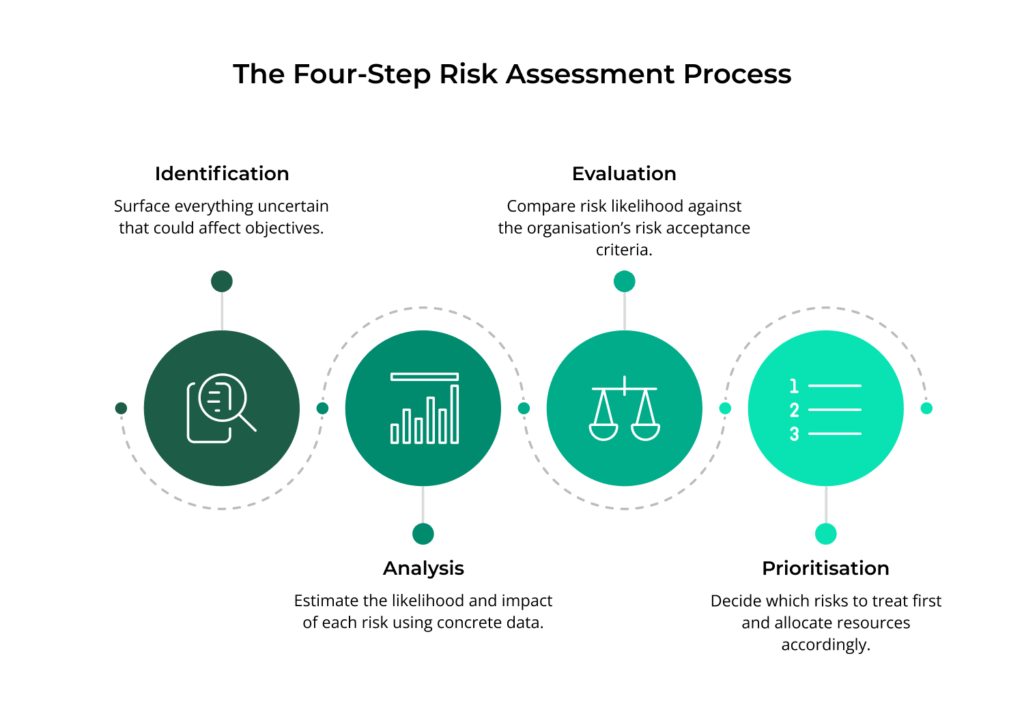
- Identification. At this stage, the goal is to, unsurprisingly, identify all the potential risks. Bearing in mind the definition of risk contained in ISO 31000, the point is to surface everything uncertain that could affect objectives.
- Analysis. This is where an estimate of the likelihood and impact of each risk is established. Be mindful that “estimate” does not mean “guess.” Even for risks that might seem obvious, it is better to collect concrete data, which can be used at later stages of the process.
- Evaluation. Now that the likelihood of each risk is known, it can be compared against the organisation’s risk acceptance criteria. These — specifically risk appetite and risk tolerance — will be discussed in detail later. What is important to remember now is that these “lines in the sand” should have been established earlier and depend on the nature of the organisation (obviously a crypto exchange has a higher acceptance of risk than a pension fund).
- Prioritisation. Knowing how likely and how severe a risk is, as well as how it measures up against the organisation’s acceptance criteria, one can decide which risks to treat first and how many resources to dedicate to addressing them.
The ISO 31000 process also includes two continuous activities running alongside the whole process: communication & consultation, and establishing the context (scope, objectives, criteria).
The output of the process is a risk register that not only lists the risks with their descriptions, likelihoods, scores and treatment decisions, but also assigns owners to them, to ensure responsibility for handling the risk.
You Can’t Defend What You Can’t See: How Do You Identify Risks?
Identification is the first stage of the risk assessment process, on which all else rests. While it in itself does not solve much (only in an informal way, by letting people know what to look out for), if it is not comprehensive, gaps will be left in the risk strategy at all other stages. It is also, therefore, the hardest to amend without potentially interfering with the whole structure.
So how does one identify risks? Some risks may be obvious, but the point of the exercise is to identify the less obvious ones. There are a couple of interesting methods that can be applied here. ISO/IEC 31010 catalogues 30+ formal identification and assessment techniques (FMEA, bowtie, fault tree, etc.), but let’s only discuss a few of them in general.
- Cross-functional brainstorming workshops involving a variety of people from all relevant departments — IT, operations, finance, legal, HR, frontline staff, whoever touches the process or system being assessed. The more different perspectives, the better.
- Structured interviews with stakeholders. Again, go for variety. Also, the structured part is important — develop a questionnaire so that the answers are comparable and nothing important is missed.
- Surveys of team members. These are less open than interviews but allow you to gather data from more people. As always, the diversity rule applies.
- Review of past incidents and historical data. This is very valuable for processes with long histories and does not have to be limited to the organisation’s own history. Learning from others’ mistakes is a great idea. And don’t mind if the issue has already been addressed — it still needs to be in the report, and perhaps new solutions have emerged.
- Checklists and standard risk taxonomies. Use a pre-built list of known risk categories (perhaps from a standard or past projects) to systematically check which ones apply to your organisation (rather than relying purely on memory or imagination).
- Process mapping. Draw out each step of a process in sequence and ask, at every single step, what could go wrong here. FMEA (Failure Mode and Effects Analysis) is an example of formalised process mapping. It involves going through a system piece by piece and asking: “how could this part fail, and how bad would that be?”
- Scenario analysis. Construct detailed, plausible narratives of specific ways a risk could unfold, to surface risks and consequences that a simple list of categories wouldn’t reveal.
- Benchmarking against industry standards and/or peers. Look at what risks and incidents have affected similar organisations, or what a recognised standard flags as typical for your sector, on the assumption that risks common to your peers are probably relevant to you too.
- Fault Tree Analysis (FTA). Start with one bad outcome and work backwards to map every combination of failures that could cause it.
- Bow-tie analysis. Put one risk in the middle of a diagram, with its causes and preventive controls on one side and its consequences and mitigating controls on the other.
Likelihood Meets Impact: How Do You Analyse and Evaluate Risk?
Two parameters are evaluated for each risk at the analysis stage: likelihood/probability (how likely is this to happen?) and impact/consequence (how bad would it be?). Analysis also involves studying the sources or causes of each risk and the effect existing controls have on it.
Evaluation, in turn, consists in comparing the results of analysis against risk criteria (discussed below) to decide if the risk is tolerable. Evaluation answers whether this is a risk the organisation might accept and whether it’s within tolerance. Should it be treated or accepted? The output of the evaluation stage is a ranked list of risks accompanied by a treatment recommendation for each of them.
The Risk You Can See: What’s the Difference Between Inherent and Residual Risk?
These two categories of risk matter for the analysis and evaluation stage. Inherent risk is the level of risk before any controls or mitigation are applied. It reflects the raw exposure to uncertainty created by doing business at all. For example, an online payments business has high inherent breach risk simply because it holds financial data.
Residual risk, in turn, is the risk that remains after controls and treatments are applied. In other words, it is the organisation’s actual exposure under given conditions. Controls can reduce the likelihood and/or impact of risks, but no control eliminates them entirely. Residual risk must still be documented, monitored and reviewed, as sometimes further treatment is needed or new possibilities emerge.
If you track only one of these two, you will inevitably either understate exposure or overstate control strength. Tracking only inherent risk ignores the value of controls, while tracking only residual risk hides how effective the controls are.
How Much Is Too Much? Risk Appetite vs Risk Tolerance
These are two easily confused terms. Risk appetite defines the level of risk an organisation knowingly accepts in pursuit of its goals. Organisations may accept different levels of risk at different stages of their development – a start-up will be more willing to take risks than an established company. Appetite can also vary across activities even within the same organisation: a bank may have a high risk appetite for capital investments while holding near-zero appetite for regulatory compliance or data security. Risk appetite is a strategic factor: it is set at board level and remains relatively stable.
Risk tolerance, on the other hand, is the permissible deviation from the accepted level for a specific risk or process. Unlike the previous category, it is an operational factor and can vary depending on the specific process or circumstances. If a firm generally tolerates a ~1% risk, how much will it accept for an activity with high potential returns? 2%? 10%? That is the question answered by risk tolerance.
Both risk factors directly shape decisions around responding to risks. A risk-averse organisation may retain bigger risks than normal if the potential upside justifies it. For example, a normally risk-averse pharmaceutical company might gamble on a new vaccine during a pandemic (because of the potential market demand and human necessity).
Without defining the organisation’s risk appetite and risk tolerance, prioritisation becomes guesswork and spending is hard to justify. These factors are what residual risk should be compared against to judge if it’s acceptable.
Beyond Gut Feeling: Qualitative or Quantitative Risk Assessment?
These are two different methods of assessing risk, both of which have their own pros and cons.
Qualitative risk assessment rates the likelihood and impact of an adverse event using descriptive labels, such as low, medium and high, and relies on the assessors’ perception and experience. The advantages of this approach are that it is fast and cheap, requiring minimal inputs and maths, and leveraging expert judgement. The disadvantage is that it is subjective and hard to compare across risks. The typical output of a qualitative risk analysis is a colour-coded risk matrix.
Quantitative risk assessment, on the other hand, assigns numerical values to estimates of probability and impact. While the former is still somewhat arbitrary, the latter can be expressed in currency, representing the potential loss of money from an adverse event. This makes it both understandable and convincing. It is an objective and data-driven approach that uses statistical analysis and mathematical models. The pros of quantitative assessment are that it is precise and comparable, supports cost-benefit decisions, and speaks convincingly to modern managers and investors, who tend to see business as a numbers game. The downside, however, is that quantitative assessment depends on good historical data, which most organisations lack, and generally requires more time and expertise to do properly. Therefore, it is most common in mature, data-rich sectors, such as insurance, finance, nuclear, or aviation.
The middle ground is semi-quantitative assessment, which involves qualitative categories with numerical scales attached. It lets scores roll up and be aggregated and compared across risk types. The risk matrix is the most common semi-quantitative tool. In practice, the best approach is to start with qualitative risk assessment and move toward quantitative as data maturity improves. Remember that risk assessment is a continuous process.
Plotting the Unpredictable: How Does a Risk Matrix Work?
The risk matrix has already been mentioned twice, so it’s probably time to explain what it is. In simplest terms, it is a graph that plots the likelihood of risks on one axis and their impact on the other. Thus, the ones that are most likely to cause the most disruption are positioned at the top and to the right. It is a clear visual representation of which issues are the most urgent and should be addressed first, making it as much a communication tool as an analytical one.
The most common format of a risk matrix is a 3×3 or 5×5 grid. Typically, each cell is colour-coded (usually from green to red) to show the combined risk level, as seen in the example illustration below:
- High-likelihood and high-impact (red) = act immediately.
- Low-likelihood and low-impact (green) = accept or just monitor.
Valuable though the risk matrix is for analysis and (even more so) for communicating results, it is not without its flaws. Firstly, it is only useful if scoring criteria are standardised and agreed across the organisation. If there is no common definition of what low, medium and high actually mean, the matrix is of little value (jokingly referred to as “a colourful disagreement”). Furthermore, it creates a false sense of precision, which does not reflect the limitations of qualitative assessment. It is also common for high-impact, low-probability risks to get systematically underweighted.
Reduce, Transfer, Avoid, Accept: How Do You Treat Risk?
Now that all the risks have been identified and assigned priorities, decisions must be made about how to address them. The four standard treatment options are: Reduce, Transfer, Avoid, and Accept.
To reduce or mitigate a risk is to add controls and procedures that lower its likelihood or make its impact less painful. There are as many ways to mitigate risks as there are risks. Common ones involve, for example, training, which can help staff members spot an upcoming problem and prevent it, or teach them to react when the problem occurs. This is why we have fire drills. Other common methods include restricting access to vulnerable facilities, equipment, or data. Speaking of data, the two simplest ways to mitigate a whole host of related risks are to introduce two-factor authentication and to make backups. Fires, data leaks, ransomware attacks, and hard-drive failures will never be eliminated completely, but with the right mitigation tools they can be made less likely and/or their impact minimised.
Transferring a risk involves shifting the financial and/or operational responsibility to a third party. The most obvious risk-transfer method is insurance, where the insurance company takes on the financial responsibility for the cost of an adverse event (or a part of it). This is most common for force majeure or civil liability insurance. The former is a risk that cannot be eliminated or even mitigated in some cases, so the best way to offset it is insurance. The latter can be mitigated in numerous ways but, because of the costs often associated with liability, most organisations have a final safety net in the form of insurance. An alternative to insurance is contractual indemnity, where one party to some other contract agrees to cover the cost of specified adverse events. This can work both ways between customer and provider. For instance, in rental contracts it is typically the customer that takes on the liability for, e.g., any harm associated with using the rented asset. Whereas, for example, in licensing contracts (such as software or copyrighted materials) it is often the service provider that takes on responsibility for any issues caused by the licensed software, materials, etc. Another way to transfer risk is outsourcing, where an external entity takes on a given task along with the associated risk. Although it should be noted that outsourcing can in itself be a source of risk, so it should be carefully considered, particularly when it comes to data security.
To avoid a risk, simply stop doing whatever the risk is associated with. This can be a particular activity, piece of technology, or a project that is abandoned entirely to remove the risk — for example, by exiting a specific market, dropping a product line, etc. A good current example is the adoption of AI: many companies invested in it, some even fired employees, but — as the MIT NANDA report The GenAI Divide: State of AI in Business 2025 shows — most saw no benefit and many had to walk back the changes they had made. One way to avoid this risk entirely would have been to not adopt unproven, hyped-up technology at all.
Finally, one can accept a risk consciously and continue on with a known risk. While this may seem unreasonable, sometimes a low-likelihood, low-impact risk is so difficult or expensive to mitigate that it is simply not worth the bother. For example, last year the Iberian Peninsula experienced a peninsula-wide blackout. A business dependent on electricity could mitigate the risk, and indeed some did — a few ATMs were working, as well as some cell-phone towers, and mom-and-pop stores operated cash only. However, for most companies this is such an exceedingly rare occurrence that simply losing one day of business is not worth the hassle of preparing for it. Another example comes from Poland: in Białystok, the main cycling thoroughfare dives under road bridges along the river to avoid traffic. This means that a few dozen metres of it can occasionally be flooded. Could this be prevented? Probably, but mitigating an issue that occurs once a year at worst just isn’t worth it. Thus, the city authorities simply installed warning signs and accepted the necessity of occasionally removing a few centimetres of mud from the cycling lane.
It is very important to document every treatment decision, all the more in the case of acceptance, which does not leave much of a trail (since no actions are taken). At the same time, from the point of view of stakeholders, there is a world of difference between conscious, deliberate risk-taking and exposure to risk through negligence. Documentation of the process is evidence of due diligence, especially when acceptance decisions are accompanied by treatments (mitigation strategies) applied to other risks.
Risk treatments become controls once implemented. Controls are defined in ISO 31000 as any policy, procedure, practice, process, technology, technique, method or device that modifies risk. What is also crucial is to re-measure residual risk after treatment to confirm it’s within tolerance.
Standards That Stick: Where Does Risk Assessment Sit in ISO 31000, 27001, and 22301?
ISO 31000 is the general risk management standard: a set of principles and guidelines that any organisation, in any sector, can use to structure how it manages risk. It lays out the risk management process this article has been following throughout: establish the context, identify risks, analyse them, evaluate them, treat them, then monitor and review, with communication and consultation running alongside the whole thing. Its companion standard, ISO/IEC 31010, is where you go for the how: it catalogues more than thirty specific techniques for identifying and analysing risk, from simple tools like the risk matrix to more rigorous ones like FMEA, fault tree and bow-tie analysis. One thing worth being clear about is that ISO 31000 is guidance, not a certification standard. An organisation can align its practices with it, and even get an informal audit against it, but there’s no “ISO 31000 certificate” to hang on the wall.
ISO/IEC 27001, by contrast, is a certifiable standard, and risk assessment sits right at its core. It’s the international standard for information security management systems, and any organisation implementing it is required to carry out a formal risk assessment as a foundational step. That assessment is what determines which of the security controls listed in the standard’s Annex A are actually relevant and need to be applied. You don’t implement every control by default; rather, you implement the ones your risk assessment says you need. Usefully, the risk assessment process that ISO 27001 requires maps directly onto the general ISO 31000 process described above, so an organisation already comfortable with 31000 isn’t starting from zero when it turns to information security specifically.
ISO 22301 applies the same underlying logic to a different problem: business continuity. It’s the standard for business continuity management systems, and here too, risk assessment is what does the groundwork. It’s how an organisation works out which disruption scenarios (a cyberattack, a supplier failure, a natural disaster, a pandemic) are plausible and serious enough to warrant a continuity plan. Across all three of these standards, the throughline is the same: risk assessment isn’t a one-off compliance exercise bolted onto a certification — it dictates what an organisation actually needs to do, whether the goal is general risk governance, information security, or staying operational when something goes wrong.
The Bottom Line: Summary and Key Takeaways
- Risk assessment is a continuous, structured process, not a one-time task.
- Inherent (before treatment) vs residual (after treatment) risk: track both, or you misjudge your real exposure.
- Risk appetite (how much risk you are normally willing to take) and risk tolerance (how much more risk you are occasionally willing to take) set the bar for what’s acceptable.
- Assessment methods scale with data maturity, from qualitative through semi-quantitative to quantitative.
- The risk matrix is useful only with consistent, agreed-upon scoring applied across the organisation.
- Four ways to treat risk.