

DORA vs NIS2 – which regulation applies to your organisation, and what are the key differences between them? DORA (Digital Operational Resilience Act) and NIS2 are two of the most important EU regulations aimed at strengthening cybersecurity and ICT risk management, but they apply to different sectors and impose different compliance obligations. In this article, we compare DORA and NIS2, explain their main similarities and differences, and outline the requirements related to risk management, incident reporting, ICT third-party providers, and management accountability. You will also learn which organisations fall under DORA, which are covered by NIS2, and how to efficiently achieve compliance with both regulations through a unified governance, risk, and compliance (GRC) approach.
Imagine a scenario that has become increasingly common across Europe. The board learns that the organisation may fall under new cybersecurity requirements. The security team starts reviewing NIS2. The compliance function is hearing more and more about DORA. IT teams are assessing whether existing controls and processes are sufficient. Questions quickly emerge:
Where should we start? Which framework applies to us? Do we need two separate compliance programmes? What are the risks of getting this wrong?
From my experience, this is where many organisations encounter their biggest challenge. The difficulty is rarely understanding a single requirement in isolation. The real challenge is navigating an increasingly complex compliance landscape. DORA, NIS2, GDPR, industry-specific guidance, customer expectations, and audit requirements all create a web of obligations that often, but not always, overlap.
Cybersecurity and operational resilience have become strategic priorities across both the European Union and the United Kingdom. Rising cyber threats, growing dependence on technology, and increasingly complex supply chains are driving authorities to expect a more structured and risk-based approach to governance and risk management.
Against this backdrop, two legal frameworks have become particularly important: DORA (Digital Operational Resilience Act) and NIS2. Both aim to strengthen organisational resilience against digital threats, but they differ in scope, level of detail, and the organisations they affect.
What is DORA (Digital Operational Resilience Act)?
The Digital Operational Resilience Act (DORA) is an EU regulation designed to strengthen the operational resilience of the financial sector. Its objective is to ensure that financial institutions can prevent, withstand, respond to, and recover from ICT-related incidents and disruptions.
Unlike many previous legal instruments, DORA is not focused solely on cybersecurity. It takes a broader view of operational resilience and requires organisations to manage ICT risks, oversee technology providers, report incidents, and regularly test their resilience capabilities.
Because DORA is an EU regulation rather than a directive, it applies directly across EU member states without requiring national implementation. The regulation became applicable in January 2025.
What is NIS2?
NIS2 is the successor to the original Network and Information Systems (NIS) Directive and represents one of the cornerstones of Europe’s cybersecurity strategy.
Its primary objective is to raise the overall level of cybersecurity across the European Union by introducing common requirements for organisations operating in critical and important sectors.
Unlike DORA, NIS2 is a directive. This means individual member states must transpose its requirements into national legislation. While the overall objectives remain consistent, some implementation details may vary between countries.
NIS2 applies to a much broader range of sectors than DORA, including energy, transport, healthcare, digital infrastructure, IT services, public administration, water management, and many others.
DORA vs NIS2: Key Similarities
Although DORA and NIS2 target different types of organisations, they share many common principles.
Both frameworks:
- Require a risk-based approach to security and resilience
- Introduce incident reporting obligations
- Address third-party and supply chain risks
- Increase executive accountability for cybersecurity
- Promote operational and organisational resilience
In practice, this means many processes implemented to satisfy one framework can also support compliance with the other.
What are the differences between DORA and NIS2?
The most fundamental difference lies in their legal nature. DORA is an EU regulation and applies directly across member states. NIS2 is a directive and requires implementation through national legislation.
There are also significant differences in the level of detail. DORA introduces highly specific requirements covering ICT risk management, incident reporting, resilience testing, and third-party risk management. NIS2 provides a broader framework and gives organisations more flexibility in how they achieve compliance.
One way to think about it is this: NIS2 focuses primarily on what organisations must achieve, while DORA often goes much further in describing how those outcomes should be achieved.
If you’re just beginning to assess both frameworks, this distinction is one of the most important concepts to understand. It has a direct impact on project planning, resource allocation, compliance costs, and implementation timelines.
DORA vs NIS2 at a Glance
| Area | DORA | NIS2 |
|---|---|---|
| Legal type | EU Regulation | EU Directive |
| Primary objective | ICT operational resilience in financial services | Improved cybersecurity across the EU |
| Scope | Financial entities | Critical and important sectors |
| Level of detail | High | Moderate |
| Risk management | Detailed ICT risk framework | Risk-based framework |
| Third-party management | Extensive requirements | General requirements |
| Resilience testing | Mandatory, including TLPT | Less prescriptive |
| Incident reporting | Highly structured | More principles-based |
| Applicable from | January 2025 | In force since 2023, implemented nationally |
Which Organisations Are Subject to DORA and Which Fall Under NIS2?
DORA was developed specifically for the financial sector. It applies to organisations such as:
- Banks
- Insurance companies
- Investment firms
- Payment institutions
- Crypto-asset service providers
- Central securities depositories
NIS2 applies far more broadly and covers organisations operating in sectors considered critical or important to society and the economy.
In practice, some financial institutions may find themselves affected by both DORA and national legislation implementing NIS2. In these situations, organisations need to meet the requirements of both frameworks while avoiding the creation of parallel and disconnected compliance programmes.
One common misconception is that being subject to DORA automatically means NIS2 is irrelevant. In reality, the boundaries are not always that clear, particularly within large corporate groups or organisations operating across multiple sectors.
Risk Management and Cybersecurity: Do DORA and NIS2 Share Common Requirements?
Yes. Risk management sits at the heart of both regulations. DORA and NIS2 both require organisations to:
- Identify critical assets and processes
- Assess threats and vulnerabilities
- Implement appropriate security measures
- Monitor control effectiveness
- Continuously improve risk management practices
The primary difference lies in the level of prescription. DORA defines a more comprehensive ICT risk management framework, while NIS2 establishes broader organisational and technical requirements.
In my view, this is also where organisations have the greatest opportunity to reduce compliance costs. A well-designed risk management framework can simultaneously support DORA, NIS2, ISO 27001, and a range of other regulatory and industry requirements.
Areas Where Compliance Efforts Can Be Shared
| Area | DORA | NIS2 | Shared Implementation Potential |
| Risk register | Required | Required | High |
| Risk assessments | Required | Required | High |
| Security controls | Required | Required | High |
| Third-party management | Required | Required | High |
| Incident reporting processes | Required | Required | High |
| Resilience testing | Detailed requirements | General requirements | Partial |
| Board oversight | Required | Required | High |
| Compliance documentation | Required | Required | High |
Third-Party and Supply Chain Risk Management
Many of the most significant cyber incidents in recent years have not resulted from direct attacks on organisations themselves. Instead, attackers have exploited weaknesses in suppliers, service providers, or software vendors.
For this reason, both DORA and NIS2 place considerable emphasis on third-party risk management.
From my experience, supplier oversight is one of the most underestimated areas when organisations prepare for new regulatory requirements. Most organisations have a reasonable understanding of how to secure their own environments. Monitoring and managing risk across an extended supplier ecosystem is often far more challenging.
DORA introduces particularly detailed requirements in this area. Financial institutions must establish formal processes for assessing ICT providers, monitor outsourcing-related risks, and maintain comprehensive documentation of supplier relationships.
NIS2 also addresses supply chain security, but at a much higher level and without the same degree of prescriptive detail.
Incident Reporting: DORA vs NIS2
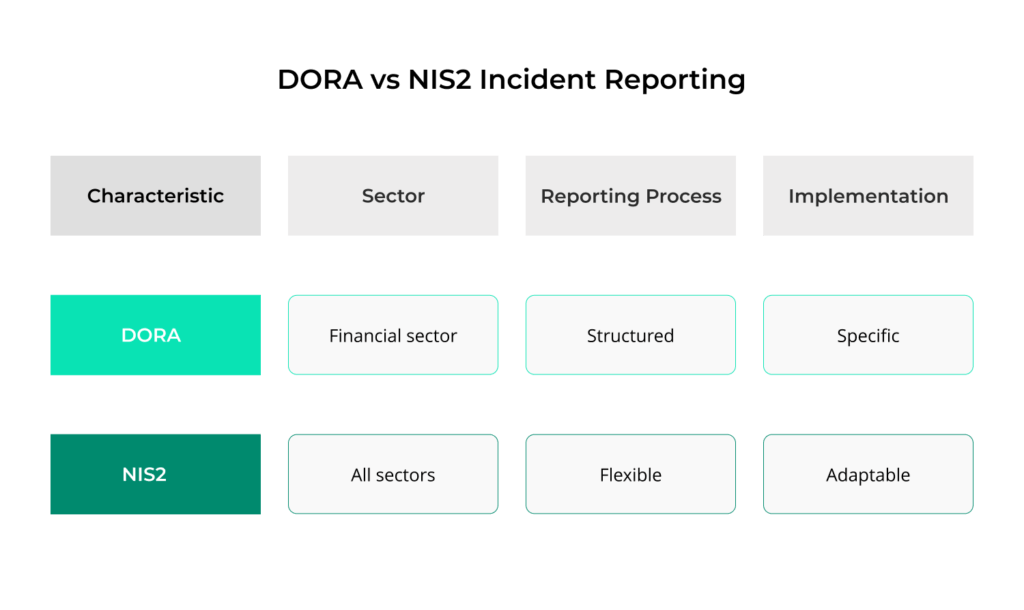
Both frameworks require organisations to report significant cybersecurity incidents, but the reporting approaches differ considerably.
DORA establishes a structured incident reporting process specifically for the financial sector. It includes defined classification criteria, reporting timelines, and reporting formats.
NIS2 also requires incident reporting but leaves greater room for interpretation and national implementation.
For organisations, this means implementing processes capable of rapidly detecting incidents, assessing their impact, and providing timely notifications to the appropriate authorities.
How Do DORA and NIS2 Influence ICT Risk Management?
Implementing either regulation typically drives a significant improvement in how organisations manage technology-related risk.
Organisations gain a clearer understanding of:
- Which systems are business-critical
- Which risks could disrupt operations
- Which suppliers represent key dependencies
- Which controls are most effective
As a result, ICT risk management becomes an ongoing business capability rather than a one-time compliance exercise conducted solely for auditors or regulators.
Resilience Testing: TLPT Under DORA vs the NIS2 Approach
One of DORA’s most distinctive features is its approach to resilience testing. It’s built around Threat-Led Penetration Testing (TLPT), an advanced form of testing based on realistic threat scenarios and attacker behaviour.
The objective is not simply to identify technical vulnerabilities, but to evaluate how effectively an organisation can detect, respond to, and recover from sophisticated attacks.
NIS2 encourages organisations to test the effectiveness of their security measures but does not introduce equally detailed testing obligations. This is one of the areas where the difference between DORA and NIS2 becomes most apparent.
Board Accountability and Regulatory Penalties
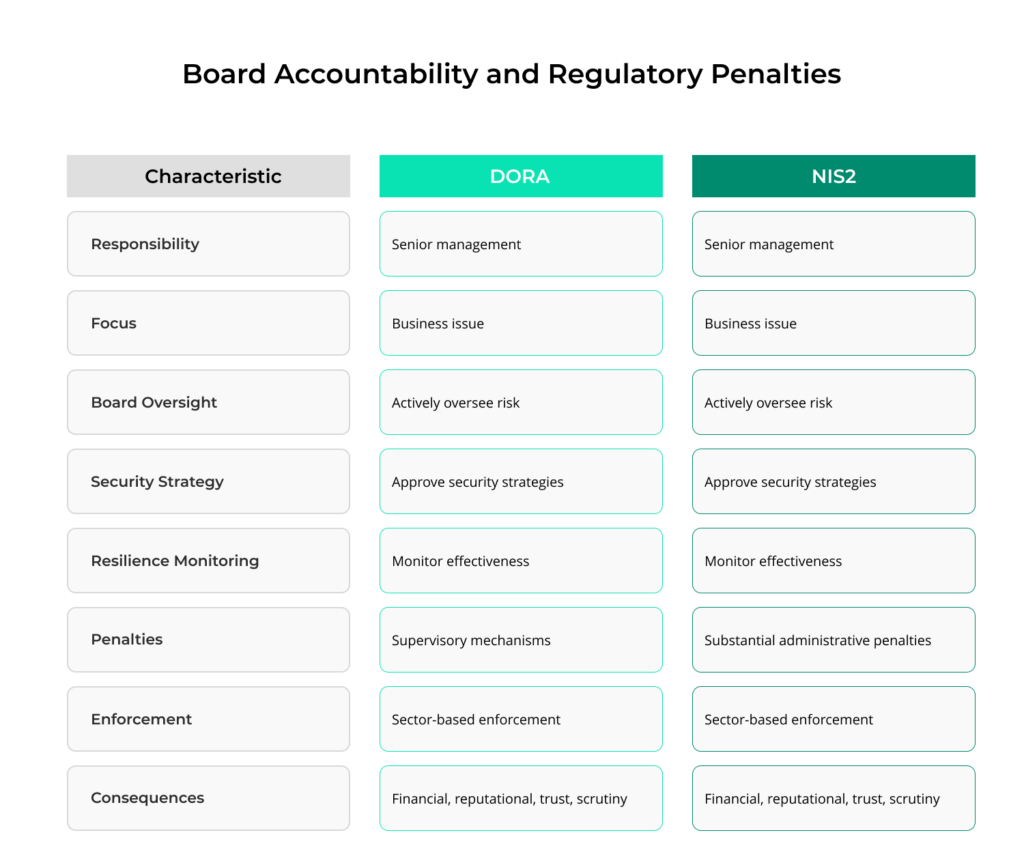
Both frameworks place significant responsibility on senior management. If you sit on a board or are responsible for risk, compliance, or cybersecurity, it is worth recognising that these areas are increasingly viewed as a business issue rather than a purely technical one.
Boards are expected to actively oversee risk management, approve security strategies, and monitor the effectiveness of resilience measures.
NIS2 introduces substantial administrative penalties for non-compliance. DORA relies more heavily on supervisory mechanisms specific to the financial sector, alongside sector-based enforcement measures.
In both cases, the consequences extend beyond financial penalties and may include reputational damage, loss of customer trust, and increased regulatory scrutiny.
DORA and NIS2 Implementation Timelines
NIS2 entered into force in 2023, with member states required to transpose its provisions into national legislation by October 2024.
DORA became applicable in January 2025.
For most organisations, the preparation phase is now over. Regulators increasingly expect to see operational processes, governance structures, and controls functioning in practice rather than existing only on paper.
How to Meet DORA and NIS2 Requirements Simultaneously
The biggest challenge is rarely a single requirement. It is managing dozens, or even hundreds, of interconnected obligations across multiple frameworks.
Common challenges include:
- Fragmented risk registers
- Limited visibility into supplier risk
- Manual control management
- Inconsistent documentation
- Difficulties producing reports for different stakeholders
From what I’ve seen, the issue for many organisations is not a lack of processes or tools. The actual problem is that they exist in multiple places, managed by different teams, with no consolidated view of risk and compliance.
Creating separate programmes for DORA and NIS2 typically increases costs, duplicates effort, and adds unnecessary complexity.
DORA and NIS2 in Practice: An Integrated Approach
Although DORA and NIS2 differ in scope and level of detail, many requirements can be addressed through a single integrated risk and compliance framework.
Such an approach enables organisations to:
- Maintain a unified risk register
- Manage suppliers centrally
- Map controls to multiple requirements
- Reduce duplication of effort
- Simplify audits and reviews
Increasingly, organisations are using GRC platforms to centralise risk management, compliance activities, controls, and third-party oversight.
This allows compliance with DORA and NIS2 to become part of day-to-day operations rather than a one-off compliance project.
DORA vs NIS2: Which One Matters More?
The answer depends on your organisation. If you operate within the financial sector, DORA is likely to be one of your most important compliance priorities. If you belong to a sector covered by NIS2, compliance with the relevant national legislation will be a critical focus.
For many organisations, however, the real question is not “DORA or NIS2?” but rather “How can we manage both efficiently?”
When I speak with organisations preparing for new compliance obligations, we often arrive at the same conclusion: the biggest challenge is managing multiple overlapping requirements at the same time.
That is why integrated approaches to risk management, cybersecurity, and compliance are becoming increasingly important. They help organisations build resilience systematically, regardless of which frameworks apply today or which new ones emerge tomorrow.