


Organisations handling sensitive data need to know exactly what happens in their systems and to be able to prove it on demand. An audit trail gives them that capability by providing a complete record of actions and events across IT systems and internal procedures. This article explains the regulatory requirements that apply to audit trails, how they fit into a GRC environment, and the challenges that come with running them well.
What Is an Audit Trail?
An audit trail is an automatic, chronological record of actions and events occurring across an organisation’s IT systems and internal procedures. Each event is logged together with information about who carried it out, when (with the precise time zone), on which resource, and what the outcome was, including any new value that a given field has taken. Such a record makes it possible to reconstruct the exact course of any operation, from the moment it was initiated through to its completion.
It is worth distinguishing an audit trail from a raw system log. Logs generated by operating systems and applications tend to be incomplete and unstructured. They capture technical events, yet they offer no guarantee of completeness and no protection against later modification. An audit trail meets a higher standard. The record is secured against subsequent changes, and its scope is sufficient for full reconstruction of events, which gives it evidential value.
In a GRC environment, an audit trail serves as a central register of events used by both internal auditors and external regulatory bodies. The organisation can answer questions about who approved a given change, when a particular operation took place, and whether it followed the established procedures.
Why an Audit Trail Matters for Your Organisation
The mere awareness that every action in a system is being recorded has a real influence on user behaviour. Employees are less likely to attempt unauthorised operations when they know they are leaving a verifiable trace. This preventive effect of the audit trail forms a first line of defence against internal misuse.
A second value emerges once an irregularity does occur. Thanks to a complete record, a security team can quickly establish who took the problematic action, when, and what consequences it had for other parts of the system. A shorter response time translates directly into reduced losses, both financial and reputational.
The audit trail also strengthens internal control. An auditor verifying the effectiveness of control mechanisms has objective data on how procedures actually operate in practice. They can refer to specific event records and check whether a given mechanism actually worked at the required moment, which improves the credibility of the assessment.
Two further functions of the audit trail are particularly important in regulated organisations. The first is data integrity. A complete and protected record makes it possible to demonstrate that the data has not been altered without authorisation. The second is user accountability, namely the ability to trace every action back to a specific person or process. Together with the requirements of process transparency and the capacity to detect errors and fraud, these functions form the foundation of compliance with most current data protection and information security regulations.
What Data Does an Audit Trail Contain?
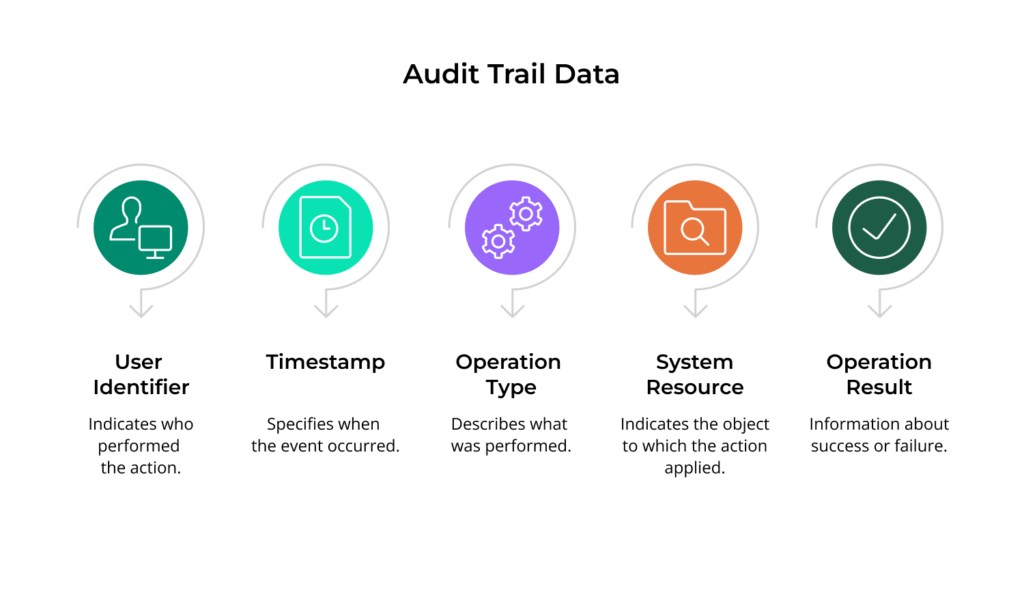
Each audit trail entry contains several pieces of essential information. The user identifier or system process indicates who performed the action. A timestamp shows when the event took place, usually accurate to the second or millisecond. The operation type describes what was done, for example a login attempt or a permission change. The system resource points to the object the action affected. The outcome of the operation, that is whether it succeeded or failed, completes the picture of the event.
Regulated industries impose additional requirements on the scope of the record. In pharmaceuticals, the audit trail has to be available for inspection by the supervisory authority at any moment and has to cover every operation on data records, from creation through subsequent changes to deletion. Missing any of these elements is a typical cause of non-conformity identified during inspections.
The presence of these data points is not enough on its own. For the record to have value during an audit or investigation, it must be complete and protected against tampering. Standard practice is to store the audit trail in a separate location to which administrators of the source systems have no modification rights. Additional safeguards such as cryptographic hashes of entries or write-once-read-many (WORM) storage prevent any alteration of history without leaving a mark. In more advanced deployments, some organisations record the audit trail on a blockchain, which makes any unauthorised modification of the event history practically impossible.
A separate question is the retention period. The decision on how long to keep the audit trail follows from regulatory requirements relevant to the industry and from the risk assessment adopted in the organisation’s security policy. The industry benchmark for ISO 27001 is 12 months of active access, although in sectors such as banking or pharmaceuticals retention periods are typically longer.
Audit Trails, Compliance and Regulation (ISO 27001, NIS2, GDPR)
Requirements for recording activity within systems appear across several major regulations that apply to European organisations. Each places emphasis on a different aspect, but meeting any of them depends on having an audit trail in place.
ISO/IEC 27001:2022 contains two controls that bear directly on this matter. Control A.8.15 (Logging) requires that records of events relevant to security be generated and properly stored. It also calls for protection of those records against unauthorised access. Control A.8.16 (Monitoring activities) goes further, imposing an obligation to actively analyse those records in order to detect unusual behaviour. The audit trail forms the technical foundation for implementing both controls, and its absence is one of the most commonly cited nonconformities during certification audits.
The NIS2 Directive introduces an obligation to report serious cybersecurity incidents in three stages. The first is an initial notification within 24 hours, followed by a detailed report within 72 hours and a final report within one month. Meeting these deadlines is only possible when the organisation has access to a reliable record of events that allows for rapid classification of an incident and identification of its scope. Without a complete audit trail, even assessing whether a given event qualifies as a serious incident may take longer than the first reporting threshold allows.
The GDPR addresses the matter through the principle of accountability set out in Article 5(2). The data controller must be able to demonstrate that processing takes place in accordance with the regulation. GDPR compliance therefore requires both the implementation of appropriate safeguards and their documentation in a manner that supports independent verification. The audit trail provides the material on which an internal audit or an inspection by a national supervisory authority can determine who accessed personal data, when, and for what purpose.
The Role of the Audit Trail in Information Security
After an incident is detected, the security team’s first task is to establish how the breach occurred and how far it extended. The audit trail provides the material for forensic analysis, that is the step-by-step reconstruction of events. It enables the team to identify the moment of first unauthorised access, follow the attacker’s movement through the infrastructure, and determine which resources they reached.
Audit trail data also feed into Security Information and Event Management (SIEM) systems, which aggregate records from multiple sources and correlate them in real time. The higher the quality of the input data, the more effective the correlation and the fewer false alarms. As a structured and complete record, the audit trail is more valuable material for a SIEM than raw application logs.
A complete historical record also makes it possible to detect unusual user behaviour. Logins at unusual hours, large-scale data downloads from an account that has never previously performed such operations, or sudden activity on an account dormant for months are signals that demand attention. Without prior reference data, detection algorithms have no way to tell normal activity from suspicious activity.
Audit Trails in GRC Systems
Mature GRC platforms treat the audit trail as one of the foundations of compliance management. The event record is automatically linked to the specific control mechanisms and regulatory requirements that apply to a given business process. As a result, an auditor verifying the effectiveness of controls does not need to gather data from numerous scattered systems but receives ready-made reports showing how procedures functioned in a given period.
An organisation using well-designed audit trail software gains current insight into the state of its processes. Any deviation from established rules, such as an attempt to approve a transaction by an unauthorised person or modification of a document outside a defined time window, triggers an automatic alert. The compliance team responds to irregularities as they happen, without waiting for periodic reviews.
A further advantage of mature GRC systems is the ability to generate reports tailored to the needs of different audiences. The board receives a high-level view of compliance status, an internal auditor sees detailed records from a chosen process, and an external regulatory body receives material organised according to the requirements of a specific regulation. All of this comes from a single database, with no manual preparation of reports.
What Challenges Come with Running an Audit Trail?
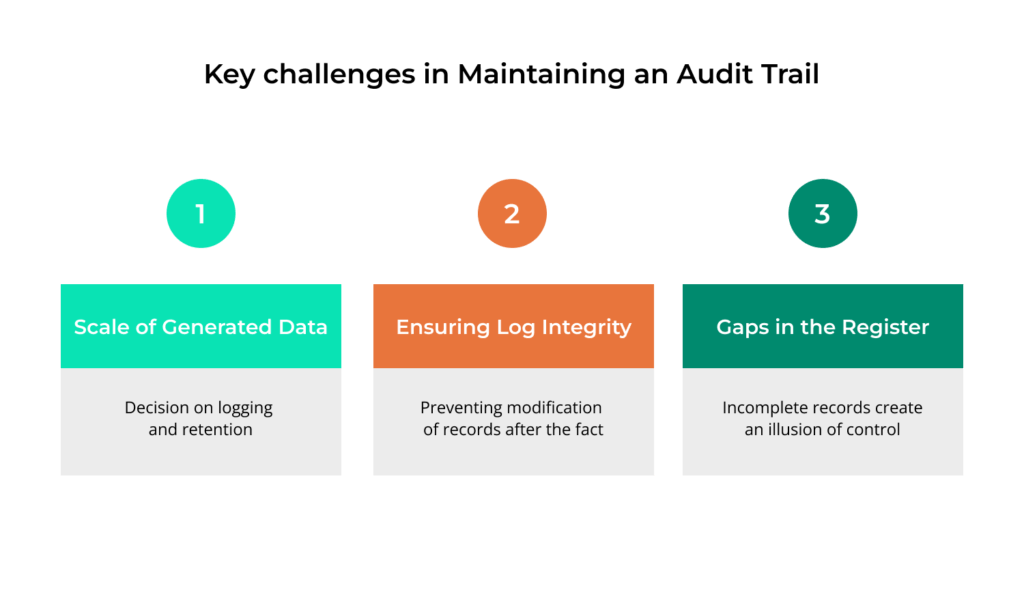
- Scale of data generated
IT systems produce thousands or millions of records every day, and the organisation has to decide what to record and how long to keep it. The decision has several aspects. GDPR compliance calls for data minimisation, which sits in tension with the need for as complete a record as possible for audit and incident analysis. The answer to this challenge is a deliberate retention policy grounded in risk assessment and the regulatory requirements specific to a given industry. - Protecting the integrity of the record
The audit trail has evidential value only when no one has been able to modify it after the fact. Administrators of source systems with full database privileges could in theory alter or delete entries. To prevent this, records should be stored in a separate location with strong privilege separation, ideally with an additional cryptographic safeguard confirming their authenticity. - Gaps in the register
An incomplete audit trail can be worse than none, because it creates the appearance of internal control where no real one exists. Missing records from parts of the system, time-stamp synchronisation delays between servers, or inconsistent data formats from different sources can make event reconstruction impossible or lead to faulty conclusions. Regular completeness testing and verification of logging configuration should be a standing part of security policy.
How AI and Automation Are Changing the Audit Trail
The traditional approach to the audit trail assumed periodic reviews of records carried out by auditors. At today’s data volumes, this model is losing its effectiveness. Artificial intelligence makes it possible to analyse millions of entries in real time, detecting patterns that a human could not spot in any comparable timeframe.
Machine learning algorithms build profiles of typical user behaviour and flag deviations. A login from an unusual geographical location, access to documents outside an employee’s remit, or a series of operations carried out at an atypically rapid pace are detected automatically and routed for review. The auditor focuses on events that the algorithm has flagged as significant, saving time previously spent reviewing random samples.
A further direction of development is continuous auditing, that is the shift from a periodic model to ongoing monitoring of processes. The organisation no longer waits for an annual review to learn about issues with internal control. It receives information about deviations at the moment they occur, which leaves time to react before a small irregularity grows into a serious incident.