


A Business Impact Analysis answers the one question you cannot guess at from your desk: which processes you have to recover first, and how quickly, before a disruption starts causing irreversible damage.
When a serious disruption in an organisation hits, the pressure of the moment leaves no room to work out priorities. Teams restore whatever feels most urgent, or whatever the loudest part of the business demands. The result is often that a process with real financial weight waits while resources go to a system that could have been left for days. A Business Impact Analysis exists so that those decisions are made earlier, calmly, on the basis of data rather than under the pressure of an incident.
A Business Impact Analysis (BIA) is the process of identifying the processes that are critical to your organisation and assessing the consequences of their interruption. It sounds simple, but the BIA is the foundation the entire business continuity plan (BCP) and disaster recovery strategy rests on. Without it, continuity plans are built on instinct, and instinct is expensive in a crisis.
What a BIA is and the role it plays in BCM
The BIA is the starting point of business continuity management (BCM). It supplies the answers that shape every plan that follows: which processes are genuinely critical, how quickly they must be restored, and what resources that restoration requires.
The scope of a BIA is wider than the name suggests. It covers not only business processes, but also IT systems, people, suppliers, and locations. A sales process does not function without the CRM system, the CRM does not function without a specific database, and the database is useless without a team that knows how to run it. The BIA maps these dependencies and shows where breaking a single link halts the whole chain.
The distinction between a BIA and a risk assessment matters here. A risk assessment asks what might go wrong and how likely it is. A BIA asks something different: once a process has been interrupted, what does that cost the organisation with every passing hour and day. The two approaches complement each other, but they answer separate questions. An effective continuity programme needs both.
What a Business Impact Analysis actually measures
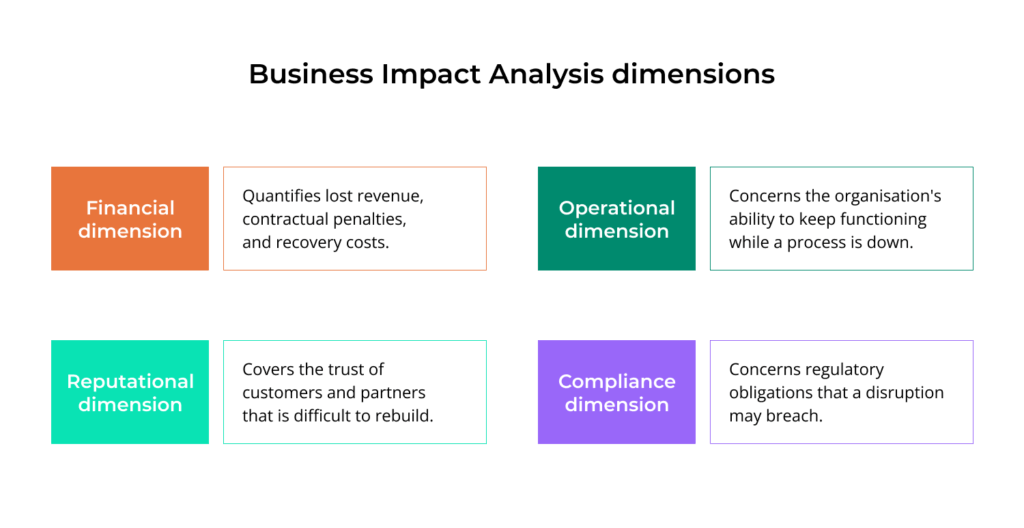
Assessing the impact of a disruption is not a matter of financial loss alone. Interrupting a process strikes four areas at once, and each requires separate evaluation.
The financial dimension is the easiest to quantify: lost revenue, contractual penalties, recovery costs. The scale is often larger than assumed. An Oxford Economics study conducted with Splunk found that unplanned downtime costs the world’s largest Global 2000 enterprises an average of roughly $200 million a year, with lost revenue the single largest direct cost, ahead of regulatory fines and SLA penalties. That breakdown is itself a reason the impact analysis cannot stop at the financial figure. The operational dimension concerns your organisation’s ability to keep functioning while a given process is down. The reputational dimension covers the trust of customers and partners, which is difficult to rebuild after a visible failure. The compliance dimension concerns regulatory obligations that a disruption may not suspend, but may instead breach.
The value of a BIA comes from assessing these dimensions not in general terms, but as a function of time. The cost also escalates sharply with each passing hour: the annual ITIC Hourly Cost of Downtime survey found that over 90% of mid-size and large enterprises put the cost of a single hour of downtime above $300,000, before any litigation or penalties are counted. A brief interruption may be manageable if teams can absorb the delay or work around it temporarily. The same interruption becomes critical when it lasts long enough to affect revenue, operations, compliance, or customer trust. This is why a BIA does more than label a process as important: it shows when downtime becomes unacceptable and which processes must be recovered first.
RTO, RPO, and MTPD: the metrics that turn analysis into decisions
Three metrics give BIA findings their operational edge. Without them, the analysis is a description rather than a basis for action.
Recovery Time Objective (RTO) is the maximum acceptable time to restore a process after a disruption. It defines how long your organisation can function without a given process before the consequences become unacceptable. RTO drives the cost of recovery solutions directly: the shorter the required time, the more expensive the standby infrastructure.
Recovery Point Objective (RPO) relates to data and sets the maximum acceptable data loss, measured in time. An RPO of one hour means the organisation accepts losing at most one hour of work. This in turn dictates how frequently backups and replication need to run.
Maximum Tolerable Period of Disruption (MTPD) is the threshold beyond which the consequences of downtime become irreversible: a customer permanently lost, or the ability to deliver on a contract gone. MTPD takes precedence over RTO. The recovery time has to fall within the limit that the maximum tolerable disruption sets. If RTO exceeds MTPD, the continuity plan is theory.
| Metric | What it concerns | The question it answers |
|---|---|---|
| RTO | Process recovery time | How quickly must we be back up? |
| RPO | Data loss | How much data can we afford to lose? |
| MTPD | Threshold of downtime | After how long is the damage irreversible? |
How to carry out a Business Impact Analysis step by step
A well-run BIA follows an ordered sequence in which each step builds on the result of the one before.
The starting point is process identification. Gather a complete list of business processes without assuming in advance which are critical. That is settled later, through analysis rather than the intuition of process owners. Input data comes from interviews with process owners, surveys, operational data, and existing documentation.
The second step is analysing the impact of interrupting each process across the four dimensions and as a function of time. For the processes judged significant, you then set RTO, RPO, and MTPD. The next step is dependency mapping: which systems, data, people, and external parties are essential to a given process. At this stage, it often turns out that a process flagged as critical depends on a system that was never treated as a priority.
The final step is prioritisation, establishing the order in which processes are recovered. This list, grounded in RTO and MTPD, becomes the foundation of the business continuity plan. The output of the whole analysis is a set of concrete results: a list of critical processes, the RTO and RPO metrics assigned to each, and the resource requirements for recovery.
A BIA is not a one-off document. Your organisation changes its processes, systems, and suppliers, and its criticality profile changes with them. A BIA from two years ago describes an organisation that no longer exists. The risk management process and the impact analysis should be refreshed on a regular cadence and after every significant organisational change.
How BIA relates to ISO 2230: mistakes to avoid
A Business Impact Analysis is one of the central requirements of ISO 22301, the international standard for business continuity management. The standard requires that an organisation conduct a business impact analysis as the basis for the entire BCM system, not as a formality attached to the documentation. For organisations pursuing ISO 22301 conformity, the BIA is not optional. It is the point of departure.
In practice, a few mistakes recur. The most common is basing criticality assessments on the declarations of process owners rather than on data. Almost every owner will consider their own process critical, which is why the analysis has to test those declarations against real financial and operational impact.
The second mistake is treating the BIA as a documentation exercise whose output goes into a binder that nobody reopens until the next audit. A BIA has value only when its findings genuinely shape continuity plans and decisions about investing in resilience. The third mistake is overlooking external dependencies. A process may be fully recoverable internally and still come to a halt because it depends on a supplier whose continuity nobody verified. This problem intensifies in multi-tenant organisations, where dependencies between units are not always obvious.
Summary
A Business Impact Analysis brings order to one of the hardest decisions in continuity management: what to recover first when you cannot recover everything at once. Its value lies not in the document itself, but in the quality of the decisions made on its basis before an incident occurs. A rigorous analysis, grounded in data rather than declarations, produces a list of critical processes, the RTO, RPO, and MTPD metrics, and a dependency map that together form a real foundation for the continuity plan and for ISO 22301 conformity. The question that matters is not whether your organisation has a BIA document, but whether its findings are current and whether anyone uses them outside the audit window.