Internal controls play a central role in risk management, compliance, and corporate governance. They help organisations reduce exposure to operational failures, financial misstatements, regulatory breaches, and fraud. Their effectiveness, however, depends on more than documented procedures. Human judgment, technology, changing business conditions, and organisational behaviour all influence how well controls perform in practice.
Understanding these limitations is essential for building a control environment that remains effective as risks evolve.
Why Internal Controls Cannot Eliminate Risk
No control framework can guarantee that objectives will always be achieved or that failures will never occur. Internal controls provide reasonable assurance, meaning they reduce risk to an acceptable level while balancing cost, efficiency, and operational needs.
This principle is rooted in COSO. The Internal Control — Integrated Framework defines reasonable assurance as the core objective of an internal control system and remains the most widely used framework in this field. This distinction is especially important in board reporting: when an incident occurs despite functioning controls, it may reflect residual risk accepted during control design. Documenting that position in advance helps avoid reassessing the same decision after the fact.
Organisations operate in environments that change continuously. New technologies, evolving regulations, business expansion, and process transformation can all affect the effectiveness of existing controls. As a result, controls require regular review and adaptation to remain relevant.
Common Internal Control Limitations
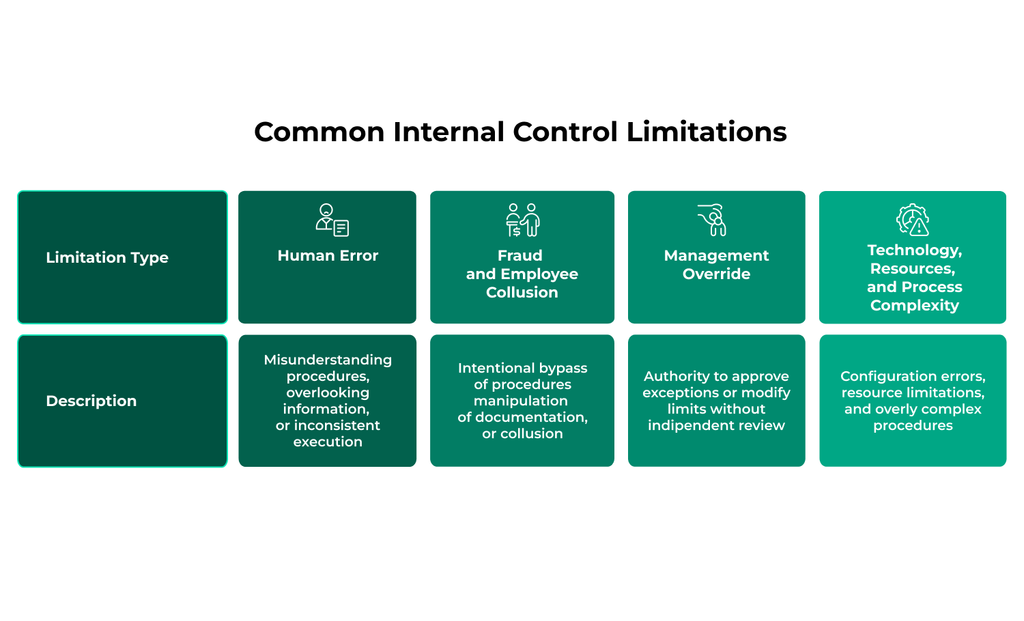
Every control environment faces inherent limitations. Some arise from unintentional mistakes, while others result from deliberate actions or organisational constraints.
Human Error
Employees may misunderstand procedures, overlook information, make incorrect assumptions, or perform activities inconsistently. Manual controls are particularly vulnerable because their effectiveness depends on individual judgment and execution.
Training, standardisation, and automation can reduce the likelihood of errors, but they cannot eliminate them entirely.
Fraud and Employee Collusion
Some failures occur because individuals intentionally bypass procedures. Fraud risks increase when employees manipulate documentation, conceal transactions, or ignore approval requirements.
Collusion can be even more difficult to detect. Controls such as segregation of duties rely on independent actions. When multiple individuals work together to circumvent controls, traditional safeguards become less effective.
The scale of the issue is well documented, according to the ACFE Occupational Fraud 2026 report, which examined 2,402 cases across 143 countries, more than half involved either missing internal controls or the override of controls already in place. The median fraud scheme lasted twelve months before being detected. When detected within the first six months, the median loss was USD 40,000; when schemes continued for more than five years, the median loss exceeded USD 1.1 million. These findings show that detection speed is one of the most important variables to manage, alongside the design of preventive controls.
Management Override
Senior managers often have authority to approve exceptions, modify approval limits, or accelerate business processes. While this flexibility may be necessary, it can also weaken established controls if exceptions are not independently reviewed.
Strong oversight, internal audit involvement, and transparent exception management help reduce this risk.
Technology, Resources, and Process Complexity
Technology can improve control consistency, but it also introduces dependencies. Configuration errors, system changes, inaccurate data, and integration failures can affect control performance.
Resource limitations create additional challenges. Organisations rarely have unlimited budgets or personnel to implement, monitor, and test every control.
Complex processes can also reduce effectiveness. Controls embedded within lengthy procedures and multiple approval layers are often more difficult to execute consistently.
How Business Changes Affect Control Effectiveness
Controls are designed to address specific risks within specific processes. Their relevance can decline when the organisation introduces new systems, restructures operations, enters new markets, or faces new regulatory requirements.
Examples include:
- ERP implementations
- mergers and acquisitions
- digital transformation initiatives
- organizational restructuring
- regulatory changes
A control mechanism may continue to operate as designed while no longer addressing a significant risk. This creates a false sense of security and highlights the importance of linking control reviews to business change rather than relying solely on annual assessment cycles.
Building Effective Internal Controls
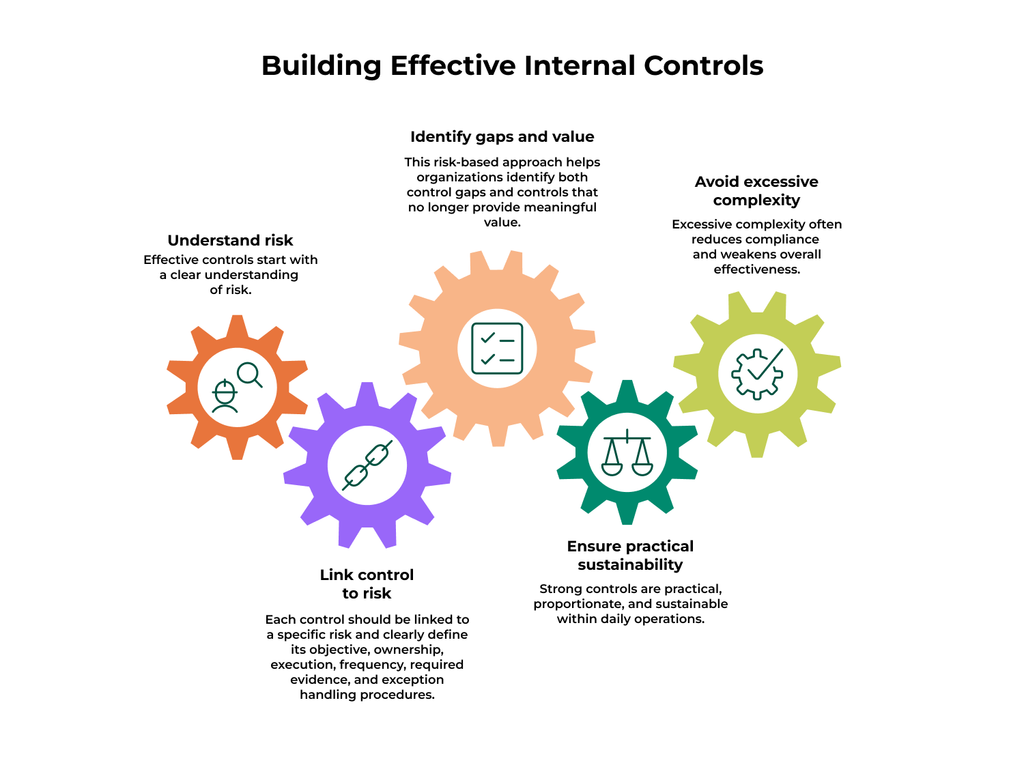
Effective controls start with a clear understanding of risk.
Each control should be linked to a specific risk and clearly define:
- its objective,
- ownership,
- execution frequency,
- required evidence,
- exception handling procedures.
This risk-based approach helps organisations identify both control gaps and controls that no longer provide meaningful value.
Strong controls are practical, proportionate, and sustainable within daily operations. Excessive complexity often reduces compliance and weakens overall effectiveness.
Monitoring and Testing Controls
Control design alone does not guarantee effectiveness. Organisations need ongoing monitoring and periodic testing to understand how controls perform in practice.
Monitoring provides visibility into exceptions, overdue activities, recurring issues, and remediation progress.
Testing typically evaluates two areas:
- Design effectiveness, meaning whether the control is capable of addressing the relevant risk.
- Operating effectiveness, meaning whether the control was performed consistently during the review period.
Separating these assessments helps identify whether weaknesses result from poor design or inconsistent execution. Timing carries weight here as well. The gap between the ACFE medians for early and late detection spans an order of magnitude, which makes time to detection one of the few control system parameters an organisation can influence directly.
Automation and the Role of GRC Technology
Automation improves consistency and reduces reliance on manual activities, particularly in high-volume processes. Automated controls are most effective when business rules are clear and repeatable.
Many organisations support their control programs through Governance, Risk, and Compliance (GRC) platforms.
A GRC solution can help organisations:
- maintain a centralised control inventory,
- map risks to controls,
- document testing activities,
- monitor performance,
- manage remediation actions,
- support management and board reporting.
Technology improves visibility and coordination, but effective controls still depend on sound governance, accurate risk assessments, and clear ownership.
Organisational Culture and the Three Lines Model
Control effectiveness depends on organisational culture as much as on policies and technology.
Employees are more likely to follow procedures when they understand their purpose and see consistent support from leadership. Accountability, ethical conduct, and open communication all contribute to a stronger control environment.
The Three Lines Model provides a clear structure for responsibilities:
- First line: business teams manage risks and perform controls.
- Second line: risk and compliance functions provide oversight.
- Third line: internal audit delivers independent assurance.
This separation of responsibilities improves transparency and strengthens governance.
Building an Effective Internal Control System
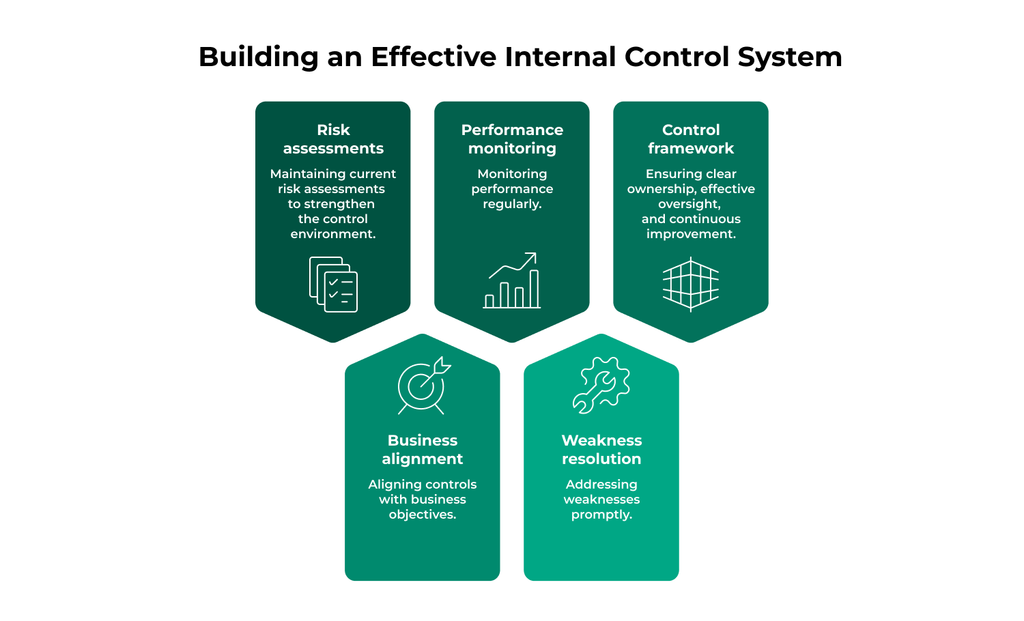
Internal control limitations are a natural part of every organisation. Human error, fraud risks, management decisions, technology dependencies, resource constraints, and business change all influence control effectiveness.
Organisations can strengthen their control environment by maintaining current risk assessments, aligning controls with business objectives, monitoring performance regularly, and addressing weaknesses promptly. Clear ownership, effective oversight, and continuous improvement remain essential elements of a resilient control framework.
Technology and GRC platforms can support these efforts, but lasting effectiveness depends on how well controls reflect current risks and how consistently they are applied across the organisation.