

You see it every day: regulatory requirements are changing fast, and your team is spending more and more time on manual reporting. Despite all that effort, some risks still slip through the cracks. You know your organisation needs a proper tool to manage governance, risk, and compliance in one place. The question is how to convince the board to invest. This article gives you the arguments you need for that conversation.
What Is GRC and Why Does It Keep Coming Up in Board Meetings?
GRC (Governance, Risk, and Compliance) is an approach that brings corporate governance, risk management, and regulatory compliance together in a single framework. Many tools on the market address only one of these areas, such as audit management or risk management in isolation. Some platforms, however, integrate all of them in one place, with a shared database and consistent rules. When choosing a GRC platform, it is worth looking at the degree of that integration, since it determines whether the organisation actually gains a complete picture of its risk and compliance position.
GRC is gaining urgency because the regulatory landscape is expanding. The NIS2 Directive requires organisations across a wide range of sectors to implement documented risk management measures. Financial institutions must also meet the requirements of DORA (the Digital Operational Resilience Act), which is enforced by national financial supervisory authorities across the EU. Investing in a GRC platform is no longer a matter of convenience. It is a response to requirements that organisations must meet.
Can Your Organisation Afford not to Have a GRC System?
Before you start talking to the board about the cost of a platform, it is worth calculating what the absence of one is already costing you.
How Many Hours a Month Does Your Team Spend on Manual Work?
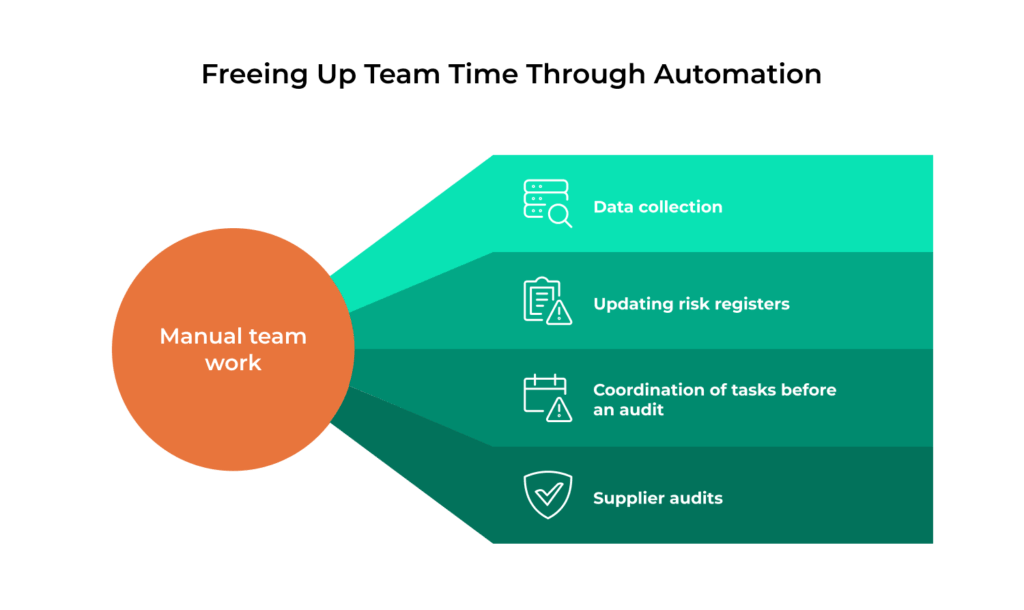
Without the right tool, pulling data from multiple sources for reports and updating risk registers take up dozens of hours each month. On top of that, coordinating tasks ahead of an audit is prone to missed deadlines, and vendor due diligence is often not carried out systematically at all. That is time your team could spend on analysing risks and actually protecting the organisation.
What Does Poor Regulatory Risk Management Cost?
Penalties for non-compliance are rising. Under NIS2, essential entities face fines of up to EUR 10 million or 2% of global annual turnover. Under DORA, financial institutions face penalties determined at national level, which in some jurisdictions reach tens of millions of euros. Beyond the fines themselves, organisations face costs that do not appear in any penalty schedule: loss of clients, reputational damage, and the expense of remediating the aftermath of an incident. According to the IBM Cost of a Data Breach Report, the average global cost of a data breach in 2023 was USD 4.45 million.
What Happens When an Inspection Reveals Inconsistent Data?
Consider this scenario. An auditor asks for your risk register, and it turns out that three departments have been maintaining three different versions in Excel. Inconsistent documentation signals to regulators that the organisation does not have its processes under control. In the context of DORA and financial supervision, this can lead to formal recommendations or, in serious cases, sanctions.
Personal Liability of Board Members
Under the NIS2 Directive, management bodies of essential and important entities can be held personally liable for failures to comply with cybersecurity risk management requirements. The specific penalties vary by member state but can include fines imposed directly on individual managers and, in the case of essential entities, temporary bans from holding management positions.
A GRC platform makes it easier for the board to demonstrate due diligence. It shows who owns each risk, what measures have been implemented, and whether policies are being followed. The system gives leadership ongoing visibility into the organisation’s GRC compliance status and makes it possible to act before minor issues escalate into serious violations. In the event of an inspection or an incident, the board can demonstrate what decisions it made and on what basis.
GRC and DORA: What Financial Institutions Need to Have in Place
Financial institutions are subject to supervision by national financial regulators, who enforce DORA’s requirements for digital operational resilience. During inspections, regulators verify risk registers, security policies, incident response procedures, and audit trails. Organisations need to demonstrate that the necessary processes are properly documented and followed.
A GRC platform allows organisations to consolidate all of this documentation in one place, linking policies to risks, controls, and their owners. Compliance management software enables much faster report generation for regulatory inspections than manually collecting data from scattered sources. Without such a tool, preparing for an inspection requires a great deal of painstaking work, and there is still a risk that the data will turn out to be inconsistent.
GRC System Versus Excel
Excel is a tool everyone knows, and many organisations start out using it for risk and compliance management. It is worth understanding when it may no longer be enough.
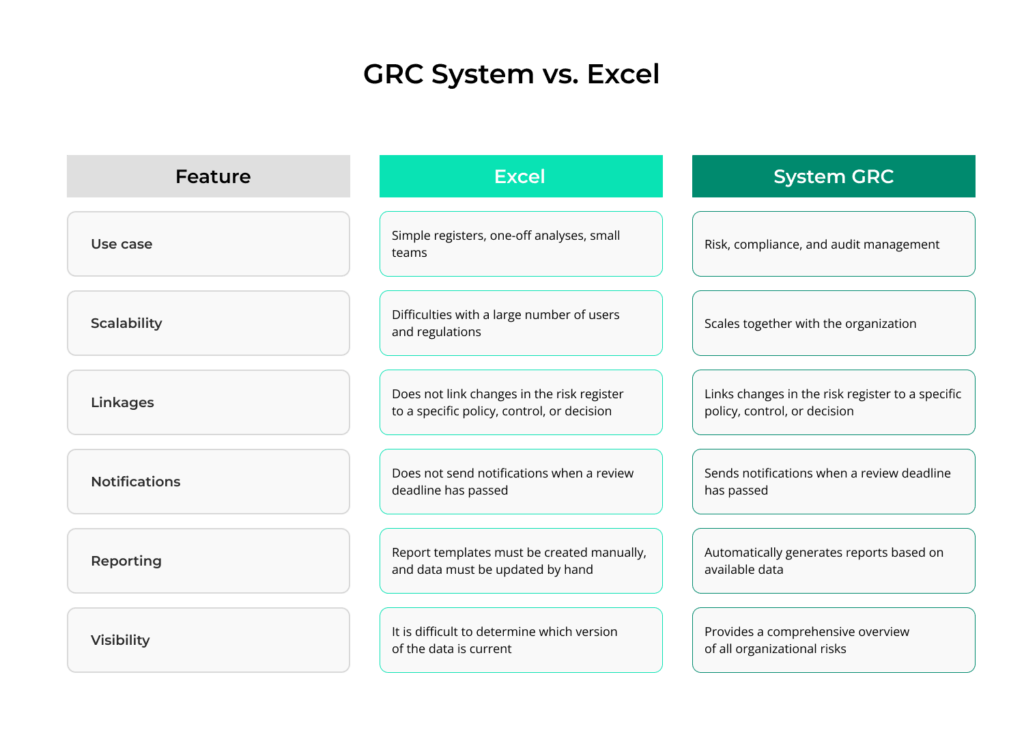
Spreadsheets work well for simple registers, one-off analyses, and small teams. Problems start when the number of users and applicable regulations grows. Even with cloud-based version history, a spreadsheet will not link a change in the risk register to a specific policy, control, or decision. It will not send a reminder when a review deadline has passed, and it will not generate the report an auditor needs. When several departments maintain separate files, it becomes difficult to establish the most up-to-date version of data, and nobody has a complete view of the organisation’s risk landscape. When you compare a GRC system with Excel, it becomes clear that a spreadsheet cannot replace purpose-built software designed for managing risk, compliance, and audits.
How to Calculate the Cost and Return on a GRC Platform Investment
Before raising the subject of budget with the board, it is worth gathering concrete data. Ask several vendors for quotes tailored to the size and needs of your organisation. When comparing offers, pay attention to the licensing model (subscription or one-off fee), the number of users included in the price, the scope of modules, and the cost of GRC implementation and training, which are usually charged separately. Check whether the vendor supports modular deployment, which allows you to spread the investment over time and start with the area that needs the most urgent attention. Also make sure the system can be extended easily, not just with standard features but also with functionality tailored to the specific needs of your organisation. A detailed comparison of selected GRC tools on the market makes it easier to assess which solution best fits your organisation.
Once you have a ballpark figure, you can set it against the costs your organisation wants to avoid: regulatory fines under NIS2 and DORA, expenses related to data breaches, and reputational damage. On the savings side, consider how many hours a month the team will reclaim through automated reporting and notifications, and how much faster the organisation will be able to prepare for audits. This kind of cost-benefit analysis gives the board concrete numbers on which to base a decision about purchasing a GRC platform.
Common Board Objections and How to Address Them
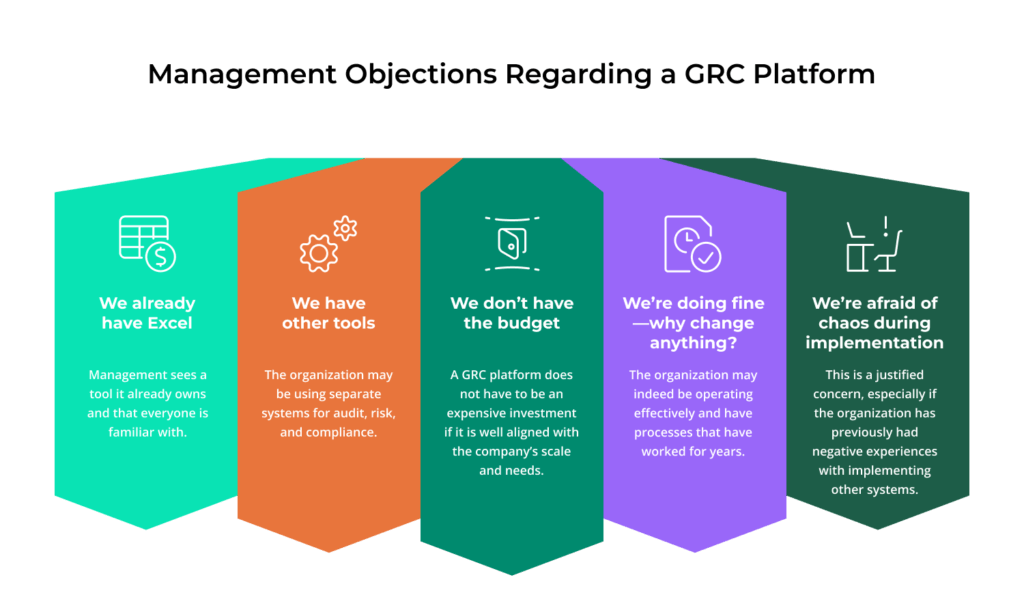
Conversations with the board about purchasing a GRC platform usually involve specific questions and concerns. Here are the five that come up most often.
We Already Have Excel, and It Is Free
The board sees a tool the organisation already has and everyone knows how to use. It is understandable that they would point to it as a suitable solution, also for GRC purposes. But it is worth asking: if a regulator came to inspect tomorrow, could the organisation produce complete, consistent risk management documentation within a few days? If the answer is “yes, but it would take several weeks and pull in people from across the business,” that is the hidden cost of Excel.
The board is not paying for the tool itself. It is paying for the time and risk that come with its limitations. There is also the question of data quality. A spreadsheet cannot guarantee that the information used to assess risks is accurate and consistent. A GRC platform enforces a uniform way of entering data, which means the board’s decisions rest on reliable information.
We Have Other Tools
The organisation may be using separate systems for audit, risk, and compliance. Each one does its job, but the data in them is not connected. When the board needs an overall picture of risks and compliance status, someone has to compile it manually from several sources. The right GRC platform replaces those separate tools with a single system where information from different areas comes together to give leadership a consistent view. When evaluating platforms, it is worth checking whether the vendor actively develops new modules and capabilities. Regulatory requirements change fast, and a platform that meets today’s needs while keeping pace with tomorrow’s helps avoid having to replace the tool again in a year or two.
We Do Not Have the Budget
A GRC platform does not have to be a large investment if it is well matched to the organisation’s size and needs. Not every organisation needs the full set of modules from day one. It is also worth showing the board what the current situation actually costs. How many people are involved in preparing documentation ahead of an inspection, and how long does it take them away from their core responsibilities? What would a data breach or a regulatory fine cost the organisation? When the board sees these figures alongside the annual cost of a platform, the budget conversation shifts from “can we afford this?” to “can we afford to keep putting this off?”
Things Are Working Fine, Why Change?
The organisation may well be performing effectively, with processes that have worked for years. The question is whether those processes can meet the requirements that have emerged recently. NIS2 and DORA require not only proper risk management but also documented evidence that risk management is in place and verifiable. An effective organisation without adequate documentation can look the same to a regulator as one that does not manage risk at all. The GDPR provided a useful lesson here. Many organisations were confident they were compliant until inspections revealed gaps, including the absence of documented data protection impact assessments (DPIAs). NIS2 and DORA set similar documentation requirements in the areas of risk management and business continuity.
We Are Worried About Disruption During Implementation
This is a legitimate concern, particularly if the organisation has had negative experiences with previous system rollouts. Mature GRC platforms, however, can be deployed in modules. The organisation starts with one area, such as risk management, and expands the system only once the first module has proved its value. There is no need to change everything at once or involve the entire organisation from day one.
How to Prepare for the GRC Conversation With Your Board
When presenting to the board, it pays to speak the language of risk and cost rather than technology alone. Concrete numbers carry more weight than general arguments. How many hours a month does the team spend on manual work? What is the potential fine for non-compliance? How does the annual cost of a platform compare with the cost of a single incident? For organisations subject to NIS2 or DORA, the personal liability of board members for cybersecurity adds further weight to these questions.
Before the meeting, it is worth preparing a few specifics:
- A summary of the time the team spends manually collecting data, updating registers, and preparing documentation for audits.
- A list of the regulations the organisation is subject to, together with the level of penalties for non-compliance.
- Quotes from selected GRC platform vendors, so the board can weigh the cost against the scale of the risk.
It is also worth meeting with a platform vendor before the board conversation to understand the tool’s capabilities and limitations in detail. After that kind of preparation, the conversation can be grounded in facts rather than a vague sense that something needs to change.
Purchasing a GRC platform is an investment in predictability and control over risk. The board is not buying another IT tool. It is gaining transparency towards regulators and protection for the organisation’s reputation. The question the board should therefore be asking is what represents the greater cost: investing in the right GRC tool, or going without one.