


In March, someone approved a deviation from the procedure. In November, the audit asks: who, on what basis and according to which version of the policy? If the answer is a shrug and a spreadsheet rewritten forty times since then, the organisation has a problem, regardless of whether the deviation itself was justified. Doing things right and being able to show that you did them right are two different skills. Modern regulations are increasingly settling accounts for the latter. Conformity is not a state, but a claim, and claims require proof.
The trail that remains: what exactly is an audit trail?
An audit trail is a chronological record of activities performed in a system. It makes it possible to reconstruct who did what, when, and on what basis. The record should be generated automatically at the time an action takes place, rather than created later for audit purposes.
In this article, we focus on how an audit trail supports compliance and accountability. We explore the definition in more detail in a separate article: Audit Trail as a Mechanism for Control and Monitoring in IT Systems and Business Processes
Compliance is a statement: why do regulations require evidence rather than assurances?
The regulations of recent years have shifted the burden of proof to the regulated entity. Older laws described prohibited behaviours and left it up to the authorities to prosecute them. Newer ones describe the expected result and require the organisation to demonstrate its achievement on request. This is most clearly expressed in Article 5(2) of the GDPR: the controller is responsible for compliance with the processing rules and must be able to demonstrate compliance with them. The Polish text of the regulation calls this the principle of accountability.
The same logic can be found in the ISO 27001 standard, which requires documented information to be retained as a testimony to the operation of processes, in the NIS2 directive and the amended Act on the National Cybersecurity System (KSC), which require an assessment of the effectiveness of the measures implemented, and in the DORA regulation, which gives the supervisor the right to inspect the risk management framework. This can be summarised with a paraphrase of a common meme: documentation, or didn’t happen. The past cannot be verified in any other way than through records that have survived from it, and the memory of witnesses can be unreliable and self-interested.
The cost of not recording was shown by the enforcement actions of American regulators against financial institutions, whose employees dealt with business matters via private messengers, outside the reach of company archives, in violation of the obligations to archive correspondence. Since the end of 2021, the Securities and Exchange Commission (SEC) and the Commodity Futures Trading Commission (CFTC) have indicted more than 100 entities, with total fines exceeding $3 billion. None of these cases were accompanied by an allegation of irregular transactions. They were punished only for the fact that the record did not exist.
Log, path, process: how is the audit trail different from regular logs?
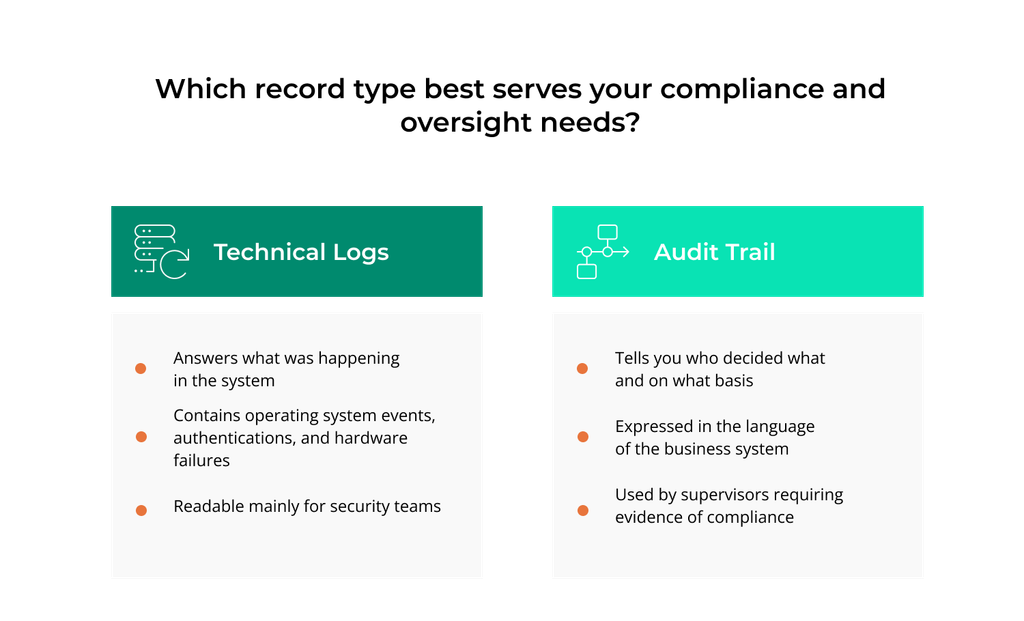
Technical logs answer the question of what was happening in the system; the audit trail tells you who decided what and on what basis. The distinction between the three layers helps here. At the bottom are infrastructure records: operating system events, authentications, network traffic, performance, hardware failures. This is a huge amount of data, readable mainly for security teams. In the middle is the application audit trail: a record of what users have done in the business system, expressed in the language of that system. Someone changed the risk assessment; someone approved the supplier. At the top is a trace of the entire process, made up of records from multiple systems, for example, a full history of policy deviation, from application to evaluation and consent to periodic review. Evidence of compliance lives in the middle and upper layers. The supervisor asking for risk acceptance does not want a stream of system logs.
Who, what, when and why: what should a good entry contain?
A user ID and a timestamp are the minimum, which is not enough in practice. A good entry answers a set of questions. Who? A specific, assignable person, not a shared account or the word “system.” What? An operation described in business language. When? Time with time zone, retrieved from a synchronised source. From where? System, module and record. And finally: why? A justification that almost no system collects, and which turns out to be the most valuable in the context of compliance.
However, the usefulness of the entry is determined by fields that are easy to forget. Previous and new value, because knowing that the field has changed, without knowing what it has changed from, is worthless. Change channel: Whether the activity was performed in the user interface, by import, by automated task, or directly in the database. In investigations, this distinction is sometimes at the heart of the matter. Approval data, including whether the approver was someone other than the requester. Finally, a correlation identifier, binding a single business event across system boundaries.
The pharmaceutical industry has codified these requirements in the ALCOA rules. The record is to be attributable, legible, contemporaneous, original, and accurate, and in the ALCOA+ extended version also complete, consistent, persistent, and accessible. The word “contemporaneous” needs to be emphasised. The record created at the time of the action has a probative weight that the record reproduced later will never achieve, even if it is reliable. Hence the advantage of automatic recording over documentation completed before the audit.
Accountability in two senses: how does the audit trail build accountability?
In the GDPR, accountability means the obligation to demonstrate compliance, and in the ISO dictionary of standards, the ability to unambiguously assign an action to a specific entity. The first meaning is organisational, the second is technical, and it is in the audit trail that the two meet: without technical attribution, organisational accountability remains a declaration.
Next to it stands non-repudiation, a stronger property in which the perpetrator cannot credibly claim that someone else acted. It is built by the strength of authentication, and in the most powerful applications, by an electronic signature. The practical enemy of all this is the shared account. Each common administrative account and each password written on a piece of paper turns an assignable action into an unassignable one, and invalidates each entry to which it relates.
The end of the evidence hunt: how does the audit trail change auditing?
A complete audit trail shortens the audit, because a significant part of the auditor’s work is obtaining evidence: correspondence with process owners, screenshots, exports from systems, printouts taken out of binders. Where a record exists, a single query replaces that entire loop.
However, it is more important to change the nature of the study. The auditor who checks whether the approval of purchases was carried out in accordance with the authorisation matrix traditionally selects a sample, usually several dozen transactions, and on this basis concludes about the whole. A searchable record allows you to examine the entire population: every commit from the entire period, programmatically checked, with an exhaustive list of exceptions. This is what continuous auditing is based on.
The audit trail proves what the system has recorded, not what has happened in the world. If the decision was made over the phone and the system was only used to record the result, the record will show the result, not the way to it. The system increases the cost and risk of tampering, but does not exclude it.
Risk register without history: why do changes to the assessment need to be justified?
A register without a history of changes is a photograph of an object in motion.
Imagine a major incident after which an audit determines that the risk was identified two years earlier, assessed as high, and quietly reduced to medium eleven months before the incident. All the questions that will be asked relate to the audit trail. Who changed the rating? Did they have permissions? What justification did they write? Has anyone reviewed this change? If the register shows only the current rating with the date of the last modification, the organisation defends a decision that it cannot explain. If it shows a change, a justification, an approver and a review, it defends a documented decision that can be criticised, but which cannot be called arbitrary. This often separates a post-inspection recommendation from a penalty.
The same is true of risk acceptances. An exception granted for three months easily becomes eternal, and the record of history allows you to turn this discovery into an alert.
Not on one day, but throughout the year: how to prove the effectiveness of controls?
The external auditor does not ask whether the control works today, but whether it worked every time it should. Monthly balance reconciliation requires twelve proofs per year, each with a person and date, and evidence of what was done with the discrepancies detected. The audit trail provides this material by nature; manual collection delivers it expensively and incompletely.
The record includes the performance of inspections, test results, deviations, and corrective and preventive actions along with their fate. Most often, the last element is missing: the overview of all this by the second line. Time is a separate dimension. The record shows not only whether the inspection was carried out, but whether it was carried out on time, and chronic delays, invisible in the zero-one perspective, are conspicuous when viewed through time.
Which version was in force in March? Policies, versions, and proofs
An employee’s behaviour is assessed according to the rules that applied to them then, not according to today’s. An organisation that cannot indicate the version of the procedure in force on a given day in the past cannot defend its own people or demonstrate that it implemented the requirement before the event, not after it.
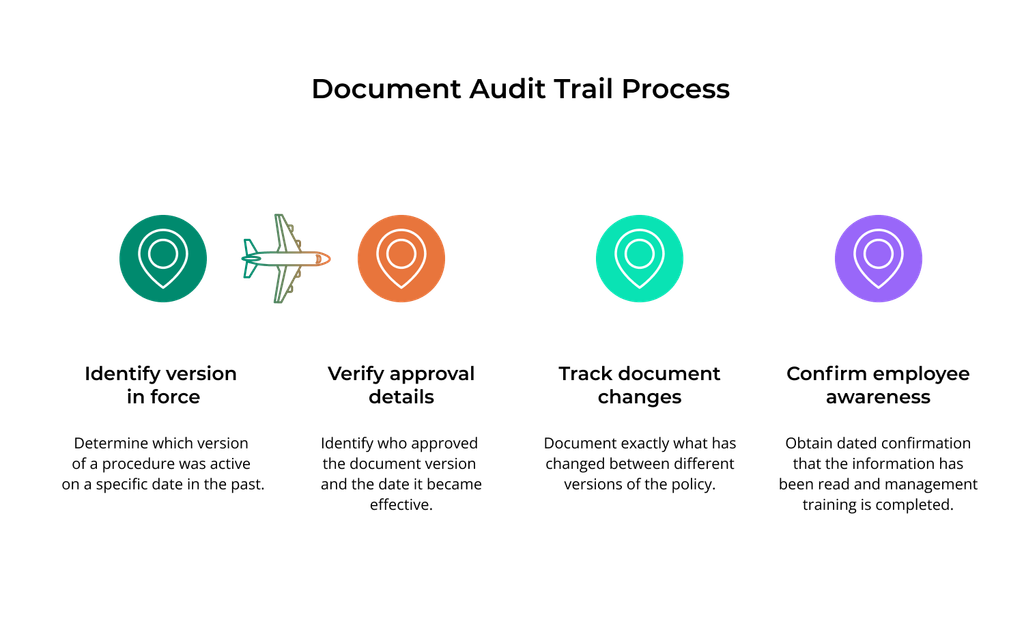
The audit trail of documents answers the following questions: which version was in force, who approved it, since when, what exactly has changed, and who has confirmed that the information has been read. The latter element is sometimes unjustly neglected, because the amended KSC Act has gone further than the directive itself and requires management training confirmed by a document. The proof of awareness is a dated confirmation.
The clock is ticking: how do we know when we found out about the incident?
Each deadline for reporting runs from the moment the information is received. The GDPR gives 72 hours to report a data breach. The amended Act on the National Cybersecurity System, for NIS2, requires an early warning in 24 hours, a report in 72 hours and a final report in a month. DORA imposes its own multi-level reporting requirements on the financial sector.
The question of when the organisation found out is answered only by the records: a monitoring alert, a report to the internal hotline, a message on the team’s channel, a formal escalation, each with its own timestamp. Without them, the company guesses about the only fact that determines the timeliness of the report. Outside of the deadlines, the audit trail is used to reconstruct: what the attacker actually did, what data was read or changed (the scope of notifications depends on this), and what the responders did and in what order.
The scale of the consequences is shown by the British Horizon scandal, the most fateful failure of the audit trail of the digital age. Subpostmasters were convicted based on shortfalls reported by the accounting system, based on data from that system, while the organisation assured, publicly and in court, that the accounts of the outlets could not be changed remotely. This assertion was untrue: the provider’s employees could modify live data, sometimes without an attributable trace, and hundreds of wrongful judgments were based on the denial of this possibility, destroying people’s lives. An audit trail considered to be complete, but in fact leaky, can be more dangerous than the lack of it, because it gives undeserved faith in the evidence derived from it.
One person, three steps: how to detect breaches of the division of duties?
Division of duties is a preventive control, and the audit trail proves that it has worked and detects cases of circumvention. The rule is old: no one should control all the stages of the transaction that would allow for the commission and concealment of fraud.
Example. The user sets up a new vendor with an account number, then approves its invoice, and finally orders payment. Each of these actions may be allowed separately, but their sequence is a textbook pattern of abuse. It can only be detected by a correlated record with a consistent identity in purchasing and financial systems, provided that someone actually triggers this query.
Emergency access requires a separate discussion, because it is a fully justified exception: sometimes it is necessary to immediately grant elevated privileges to someone. A consensus pattern does not prohibit it, but makes it exceptional, that is, limited in time, approved, fully recorded, and reviewed after the fact.
Permissions that grow on their own: what does the audit trail say about access?
The record shows not only who has the powers, but who granted them and on what basis. Logged events include granting, changing and revoking permissions, creating and deleting an account, changing the role definitions themselves (a category that is often overlooked, although changing a role affects everyone who has it at once), and the actions of administrators.
The record answers questions from each access audit program. Do the rights increase with changes of positions, because no one takes away the old ones? This phenomenon is called “privilege creep”. Were the accounts of former employees disabled immediately? Has anyone given permission to themselves? Did the periodic recertification really take place? Imagine a manager who approves 300 permissions in four minutes. The list of approvals itself looks exemplary, but the timestamps say that no one has reviewed these permissions.
A structural weakness must be openly pointed out here: administrators can often change or delete records documenting their own activities. The answer is architecture: records must go to a storage managed by someone else – a separate log management platform under separate administrative control, write-once (WORM) media, independent retention, and, if possible, a copy outside the infrastructure of the audited system.
What the audit trail records in each area of compliance management
| Process | What’s Saved | Benefit for compliance |
| Risk management | Rating changes, acceptances, reviews | Defending documented decisions |
| Internal controls | Inspection results, deviations, corrective actions | Proof of effectiveness over the entire period |
| Policies and procedures | Versions, commits, acknowledgements | Restore status for any day |
| Incident management | Moment of detection, course of reaction, decision | Meeting reporting deadlines |
| Accesses and permissions | Grants, changes, recertifications | Detect breaches of the division of duties |
Prevent or detect tampering? Integrity and retention of records
Completely preventing modifications is practically unachievable. Standards require something more modest and wiser: that every modification be detectable. This is done by constructions without change and delete operations, write-once (WORM) stores, cryptographic hash chains, in which each entry contains a hash of the previous one, so changing one invalidates all subsequent ones, and qualified timestamps, giving the record an independently verifiable date of existence.
Synchronisation of clocks is not only good practice, but also a legal requirement: the technical standards for the DORA regulation require that the clocks of the systems be synchronised with a reliable, documented time source. With clocks running apart, the correlation of events between systems fails, and a drift of seconds can reverse the apparent sequence of two events, i.e. reverse the entire narrative of the investigation.
Retention remains a real tension. The Accounting Act requires books and evidence to be stored for years, the risk of litigation speaks in favour of longer storage, and the principle of limiting storage under the GDPR is for a shorter time, because records with user IDs are personal data and are subject to the same regime as any other processing. The solution is a documented retention matrix, differentiated by record categories and bases assigned to them, rather than a single corporate default period. Since a comprehensive record of employees’ activities is a form of monitoring, let us remind you that the Labour Code requires employees to be informed in advance and the rules of monitoring to be defined in the work regulations or announcement.
GDPR, ISO, NIS2, DORA: what do the regulations require?
None of these acts uses the term “audit trail“, but each requires the ability to demonstrate, and this cannot be built without records.
The national implementation timeline remains particularly important. The amendment to the Act on the National Cybersecurity System, implementing NIS2, entered into force on 3 April 2026. Key and important entities had six months, until 3 October 2026, to register in the official register. They have twelve months, until 3 April 2027, to implement an information security management system and connect to the S46 system.
The scale of the change deserves a separate opinion. Prior to the amendment, the Act covered about 400 entities, mainly critical infrastructure operators. After the amendment, according to the estimates of the Ministry of Digital Affairs, it will cover about 38 thousand entities, including about 27 thousand public ones. This means that the vast majority of the addressees of the new responsibilities have never undergone a security audit before and have not built evidence for external control. The Business Growth Review survey from the fourth quarter of 2025, conducted among 1018 large enterprises, showed that 38.3 percent of companies do not have defined thresholds for a major incident or do not know if they have them. Without such a threshold, it is impossible to determine when the application clock starts running. The new regulations make the head of the entity personally responsible for cybersecurity tasks.
Artificial intelligence adds a new chapter here: the EU AI Act extends the concept of an audit trail to decisions made by an algorithm. High-risk systems are to automatically record events throughout their lifecycle, and their users are to keep these records for at least six months. The regulation defines a closed list of fields only for remote biometric identification systems; for the rest, it imposes a functional requirement, i.e. a record that allows to reproduce the behavior of the system. In practice, this means that it is necessary to note the version of the model, its parameters and the context it used to generate the response.
Requirements for audit trails in the most important regulations
| Regulation | Sample requirement | The role of the audit trail |
| GDPR | Demonstration of compliance (Article 5(2)), notification of a breach within 72 hours (Article 33) | Proof of accountability; Determination of the moment of detection |
| ISO/IEC 27001:2022 | Event logging (Appendix A 8.15), monitoring (8.16), clock synchronisation (8.17) | Direct subject of certification control |
| KSC/NIS2 Act | Management system, 24h/72h/30 day incident reporting, security audit | Proof of implementation of measures and compliance with deadlines |
| DORA + Technical Standards | Event logging policy, log protection, time synchronisation | Explicitly required logging infrastructure |
| KSeF | Issuing invoices through the central system, number assigned upon receipt | The State itself keeps a conclusive record |
| AI Act | Automatic event logging in high-risk systems | Extend the recording to machine decisions |
Six systems, one question: what does the GRC platform bring?
Most organisations have numerous audit trails. They lack one thing in common.
Risk data lives in a worksheet with no history, control tests on a network drive, incidents in the ticket system, policies in the document repository, permissions in the identity system. Any of these places can record correctly, but none will answer a question that crosses the boundaries between them, and any serious question about compliance crosses such boundaries. When a supervisor asks how a specific risk has been treated, the answer touches on the risk register, the control, its test results, incidents, policy, and exception. In a distributed layout, this data must first be manually linked together, reconciling identities and timestamps between systems. In an integrated system, this is answered by a single query.
The GRC platform also brings connections: risks are combined with controls, requirements and evidence, so the auditor does not need to know which record to look for, but goes after the connections. In addition, there is the automation of recording, the immutability of history inscribed in the structure itself, and reporting understandable to the management board and controller.
However, let’s remember that the platform only records what happens within it: decisions, assessments and approvals, which is exactly the layer of evidence of compliance. It does not log events on the database server at three in the morning. It’s the job of the security monitoring layer, and a mature architecture combines the two instead of pretending that one is enough on its own.
We collect, but we don’t read: the most common mistakes in audit trails
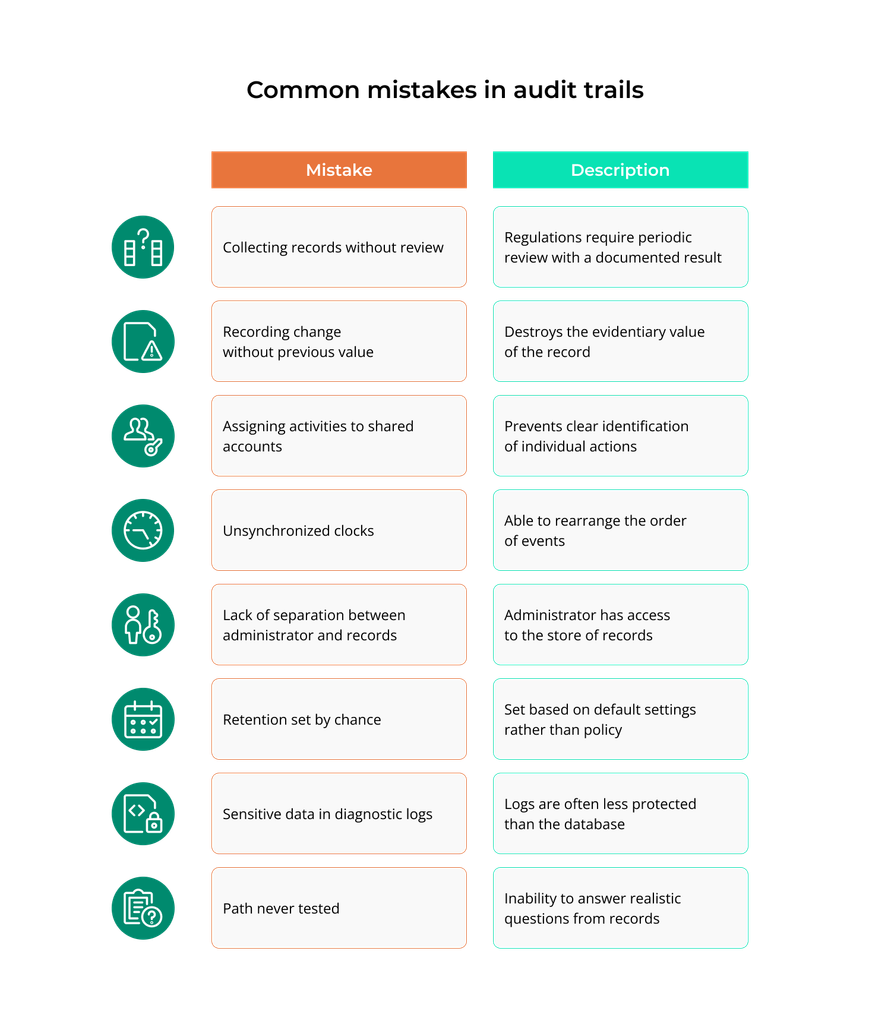
The most common mistake is to collect records that no one is reviewing. Regulations increasingly require periodic review with a documented result, so the very lack of it becomes an audit determination.
Next: Recording the fact of change without the previous value, which destroys the most evidentiary value. Assign activities to shared accounts. Unsynchronised clocks can rearrange the order of events. The above-described lack of separation between the system administrator and the store of its records. Retention set by chance, i.e. as the default setting sounded. Passwords and sensitive data end up in logs written for diagnostics, not data protection, and the log store is sometimes less protected than the database it describes.
Separately, the path that has never been tested should be mentioned. The exercise is simple: ask a realistic question to the controller and try to answer it from the records in one working day. Most organisations fail to do so the first time, and the list of deficiencies that come out along the way is sometimes longer than the entire list above.
Start with questions, not logs: how to design an audit trail?
Don’t ask what the system can record. Write down twenty questions that could be asked by the controller, auditor, court, or incident investigation team, and make sure that each one can be answered.
Record at the level of business events, not just database rows, so that the record is read by those who want to read it. Also log failed actions, because failed logins and access denials are among the most diagnostically useful events in the entire set. Require justifications, but be deliberate: If the “reason” field is mandatory for every minor change, users will quickly start filling it in with the phrase “as in the application”, invalidating the entire requirement. Duty makes sense in really important operations.
Set retention consciously, in categories. Separate the record store from the system it describes. Also limit and record access to the audit trail itself, because the record of who read the records is control over control, and an excess of eyes on raw logs is a separate risk to privacy. Browse at a set pace and document the result of the review. Finally, include the audit trail in your internal audit plan as an object of study, not just a source of evidence.
Logging priority and retention period by system type
| System or process | Logging priority | Suggested retention | Review owner | Justification |
| Financial transactions | Critical | 5 years (Accounting Act) and longer in disputes | Chief Financial Officer / Internal Audit | Statutory obligation, evidentiary value |
| Access to HR and personal data | Critical (successful and failed accesses) | 3-5 years, according to GDPR objectives | Data Protection Officer | Reporting violations, rights of individuals |
| Changes to the risk register | High | 7 years | Chief Risk Officer | Proof of the decision-making process |
| Marketing Systems | Medium, log also successful accesses | 12 months | Security Team | They process customers’ personal data |
| Development and test environments | Variable, log changes | 1-3 months | Development Manager | Change control, low financial risk |
The record is no longer kept by the company, but by the state: where are the regulations going?
The direction of change is well illustrated by the National e-Invoicing System. In the target model, each invoice is given a number assigned by the system at the time of receipt, and this number becomes the conclusive reference. The balance of power is changing: the authority no longer asks for access to the entrepreneur’s registers, but runs the system itself, which creates a conclusive record.
The whole Union is following the same path. Other countries and a package of EU changes in VAT are moving invoicing to central systems. Anyone who plans their own record architecture should understand this direction: so far, the company has kept registers and presented them to the authorities, and more and more often it is the authority that keeps the register and it is its version that resolves in the event of a dispute.
Frequently Asked Questions
Summary
Let us return to the question from the first paragraph: who approved the derogation in March and on what basis? An organization with a mature audit trail responds in a quarter of an hour and provides the name, justification and version of the policy in force on that day. This ability does not arise in the week preceding the control. It arises from the project: first the questions, then the record, and finally the habit of reading what has been written down.