

SIEM turns millions of scattered security events into actionable signals. Learn how SIEM works, supports SOC teams, strengthens threat detection and helps organisations meet compliance requirements.
Every device, application and cloud service in your organisation keeps a diary — an endless stream of log entries recording logins, connections, changes, and failures. Somewhere in that flood, the trace of an attack may already be forming… However, according to IBM’s Cost of a Data Breach research, identifying and containing a breach takes organisations over 250 days on average. SIEM solutions exist to close that gap. This article explains what a SIEM platform is and how it combines log management, advanced threat detection, and incident response in a single system… and how to choose one wisely.
From Raw Logs to Real Answers: What Is a SIEM System?
SIEM is, in short, the solution to what you might call a cybersecurity information overload problem. A SIEM system is more than just an ordinary log archive: it is a system for centralised collection, analysis and monitoring of security events from across the IT environment. Even in a moderately sized organisation the number of such individual events can go into millions – well beyond the ability of a human analyst to process efficiently. Thus, the purpose of a SIEM system is to sift through all these events, analyse them, and detect threats to support the SOC (security operations centre) by turning the ungodly number of scattered events into a handful of actionable signals.
Collect, Correlate, Alert: How Does SIEM Actually Work?
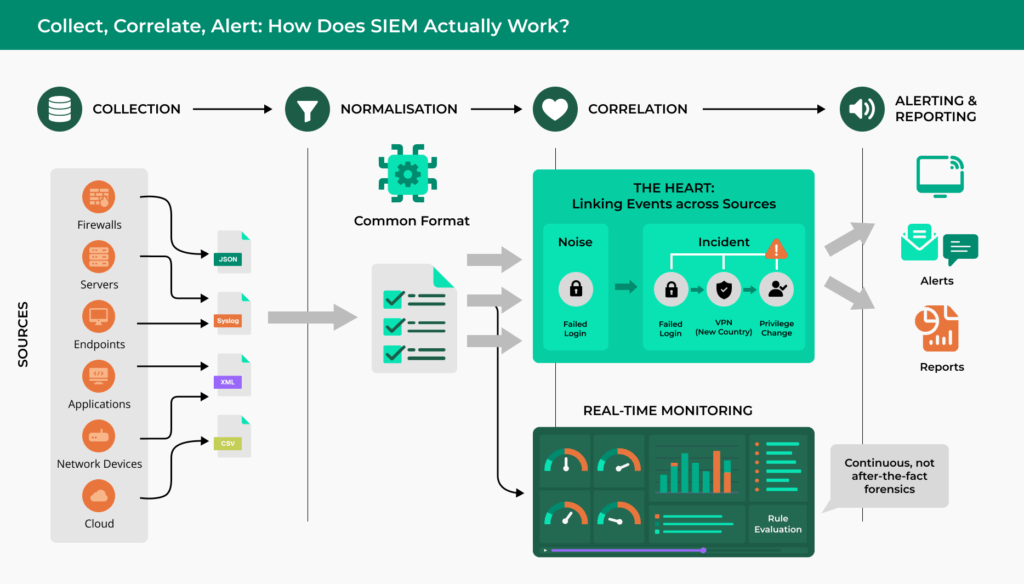
The SIEM pipeline consists of four main steps: (1) collecting logs from sources (firewalls, servers, endpoints, applications, network devices, cloud); (2) normalisation of collected data into a common format; (3) correlation – linking events across sources to spot suspicious patterns; (4) alerting and reporting. Correlation is the heart of the process, as it collates scattered events that may not stand out on their own and recognises patterns that may indicate a threat. A failed login, a login to the company VPN from an unusual location, a single account’s privilege change – all these alone are just noise, but if they happen within minutes of each other, they are a strong indication of an attack in progress. SIEM provides real-time monitoring and continuous rule evaluation, not just after-the-fact forensics, allowing cybersecurity teams to promptly respond to incidents.
More Than a Log Drawer: What Are the Key Functions of a SIEM Platform?
The core functions of a SIEM system are:
- log management
- centralised storage of logs from various sources;
- log retention, which is of twofold importance – it is required by regulations and event history is crucial for post-incident investigations.
- event correlation and threat detection – spotting anomalies and known attack patterns in the data that indicate incidents.
- real-time monitoring, alerting, and reporting
The Analyst’s Right Hand: How Does SIEM Support the SOC and Incident Response?
For the SOC (security operations centre) SIEM is effectively the console at which that team sits. It serves the analysts in three roles at once: as a triage queue, presenting the alerts that need human attention in order of priority; as an investigation timeline, letting an analyst reconstruct the sequence of events behind an alert (which systems were touched, which user accounts were involved, in what order); and as an evidence base, since the correlated log record is what the containment decision rests on and, after the incident, becomes the forensic trail for investigators, auditors, and regulators. It is worth stressing that just as a SOC is half-blind without a SIEM, reduced to checking systems one by one, SIEM without a SOC (or at the very least a named person who owns the alerts) is just a very expensive alarm ringing in an empty room.
When Seconds Count: What Do SOAR and AI Add to SIEM?
SIEM detects threats and issues warnings, but it does not act on its own. That gap is filled by SOAR, which stands for Security Orchestration, Automation and Response. A SOAR layer receives the alerts a SIEM system produces and executes predefined playbooks at machine speed, faster than any human technician could, isolating an infected host from the network, blocking a suspicious IP address, opening a ticket, or notifying the on-call analyst. All within seconds after detection, rather than the minutes or hours a human would need. The trend for the future seems clear: SIEM, SOAR, and detection tools are converging into unified security-operations platforms.
Another major addition to SIEM is artificial intelligence. Behavioural analytics (known as UEBA – user and entity behaviour analytics) learns what normal activity looks like for each user and machine, and flags deviations from that pattern, which is something that a predetermined rule would not catch. The newest platforms also employ LLMs to allow analysts to investigate incidents using plain language. This is the same logic of AI taking over repetitive work so humans can make decisions, which is behind the AI assistant in GRC.
The Paper Trail Regulators Love: How Does SIEM Support Compliance?
While I do not necessarily approve of this attitude, it must be said that for many organisations, the strongest argument for a SIEM is regulatory pressure more than cybersecurity. Right now, the most important piece of legislation in this space is NIS2, which has been implemented in Poland through the amended act on the national cybersecurity system (in force since April 2026). It gives entities covered by the act an early-warning clock of 24 hours and a notification deadline of 72 hours from detecting a serious incident. Such tight deadlines are all but impossible to meet without centralised, real-time monitoring of security events.
The financial sector faces the same logic under DORA, applicable since January 2025, which requires ICT incidents to be detected, classified and reported as early as possible (within 4 hours after classifying the incident as major, and no later than 24 hours after the financial entity becomes aware of the incident). GDPR quietly presupposes the same capability: its 72-hour breach notification deadline only works if you can detect the breach in the first place.
ISO 27001, in its 2022 edition, makes the requirement explicit, with dedicated controls for logging and monitoring, although the organisation’s information security policy defines what gets logged, who watches, and who responds. In this landscape, SIEM is the machine that produces the audit evidence, while a compliance management platform is where that evidence meets the obligations it is meant to satisfy.
Promises and Pitfalls: What Are the Benefits and the Challenges of Introducing SIEM?
There are a number of benefits of SIEM. By aggregating and sorting through logs from all systems it allows for full visibility across the whole environment. By detecting anomalies and patterns in log data, it allows for faster incident detection and response. The retention of log data creates a body of evidence to be used for incident investigations or audits. There is also a business case to be made here: security breaches are costly, so increasing cyber-resilience and reducing incident risk is a cost saver in the long run.
That is not to say that using SIEM is without its challenges. Implementation is complex, requiring integration with numerous systems, parsing incompatible logs so that they become comparable, and writing detection rules. Tuning the system correctly, lest it generate hundreds of false positives and alerts that nobody has time to read, is probably the greatest challenge. SIEM can also be costly to run, particularly in the pay-per-GB model. Finally, it needs skilled people to operate it. It is a tool, not a solution, and without a competent team it will just be shouting into the void.
All of these challenges point to the same conclusion: SIEM is not a standalone gadget that makes an organisation secure by virtue of being installed. It works when it is embedded in a broader information security management system, with a policy that defines what is monitored, people who own the alerts, and processes that turn detections into decisions. Without that framework, even the best SIEM platform is just a costly log archive with a fancy dashboard.
Buyer’s Compass: How Do You Choose a SIEM and Who Are the Players in this Market?
There are a number of factors that you should consider when choosing a SIEM platform.
- Does it cover all your actual log sources? You won’t get a complete image without it.
- What is the pricing model? The most common solution used to be the per-GB of data model, but it is being replaced with flat-fee models or SIEM being bundled with another service. However, the latter two always have some limits and switch to per-GB when they are exceeded, and in this model the data-volume economics are merciless, especially with the amounts of data modern systems generate.
- Is it a cloud service or on-premises software? The latter can be more efficient and does not build up per-GB costs but requires the right hardware and expertise.
- Does the platform include SOAR and/or AI, or are they paid extras? These can be very beneficial.
- Does your SOC team have the necessary skills? What query languages are they proficient in? In the end, the best SIEM is the one your team can actually operate and tune.
What is the SIEM market landscape as of 2026? Microsoft Sentinel has become the cloud-native default, with deep integration into the Microsoft 365 and Azure ecosystem and currently the most mature AI layer in the category, thanks to its Copilot integration for natural-language investigation. The main reason behind its popularity, though, is the bundled payment model: many Microsoft data sources are ingested for free. This comes with a caveat, however, because processing data coming from outside the MS ecosystem gets expensive fast. Splunk remains the analytical powerhouse and the platform of choice for teams that need to interrogate huge, messy data at scale. Since 2024 it has been part of Cisco. IBM QRadar, which had been the favourite of compliance-heavy industries for years, had its cloud line sold to Palo Alto Networks and shut down in April 2026, leaving only the on-premises product. A large customer base was forced to re-evaluate. Several challengers are worth a mention, aside from the big names: CrowdStrike Falcon Next-Gen SIEM, Elastic Security, Google Chronicle, and Exabeam, now merged with LogRhythm.
No Crystal Ball Needed: Where Is SIEM Heading?
What is the future of SIEM? Nobody can tell for sure but a few trends seem likely. The long term evolution trend is that SIEM is likely to be absorbed into unified platforms that also include SOAR and XDR (Extended Detection and Response), which is already eerily similar to SIEM. More recently, fast development of AI means that it is likely to move from being an add-on to being the heart of the system, allowing for natural-language hunting, auto-generated incident summaries, and agent-assisted triage. Finally, from a business standpoint, cloud-native and consumption-based models seem to be displacing heavy on-premises builds.
The Bottom Line: Key Takeaways
- SIEM is the central platform that collects, correlates, and monitors security events from across the entire IT environment.
- Correlation is where the value lies: it connects scattered events into a signal that no single system could see on its own.
- SIEM and the SOC need each other – the tool without a team is an alarm in an empty room, and the team without the tool is half-blind.
- Regulation is a major driver: the deadlines and duties of NIS2, DORA, GDPR and ISO 27001 are all but unachievable without centralised monitoring.
- Buy for fit, then tune: the best SIEM is the one your team can actually operate – untuned, it will drown you in false alarms.